

The Cognitive Gym: Why More Content Does Not Mean More Learning
A Health Education Perspective on Innovation, Inspired by the Panel “More Content, Less Learning”
Reflections by: MSc Victor Piriz Correa, MD, MPH
For over two decades, I have navigated various national and international healthcare organizations, including domestic and global academia. Lately, my work has focused on healthcare governance management and global health—fields where innovation and entrepreneurship programs are becoming increasingly paramount. If there is one phrase that encapsulates what I am witnessing today, it is this: we have never had so much access to knowledge, yet we have never learned so little from it.
This is no mere rhetorical paradox. It is the core diagnosis delivered by the panel “More Content, Less Learning” at the World Economic Forum’s Summer Summit 2026. Furthermore, it is the defining challenge determining whether economic growth in the coming years will translate into real employment across generations, or simply result in an influx of dead-end degrees for the youth.
The Mirror Held Up by AI
The emergence of generative and agentic artificial intelligence did not create this problem; it illuminated it. For decades, the healthcare educational system operated under what we might call the "transmission model": the belief that if we poured enough information into a medical student or postgraduate trainee, learning would occur through sheer accumulation. Today, we recognize with uncomfortable clarity that this model never truly worked. The difference is that previously, we lacked the means to expose its flaws so rapidly.
By providing limitless content and instantaneous answers, AI has laid bare the fact that the bottleneck was never access to information. The true bottleneck has always been, and remains, productive friction: that uncomfortable stretch of trial, error, and frustration where knowledge is forged into capability.
This explains a piece of data that should disquiet any healthcare employment policymaker: students who delegate their cognitive tasks to AI agents achieve better results in short-term evaluations, yet their retention and deep comprehension plummet markedly shortly thereafter. This is not a failure of technology; it is a failure of how we deploy it.
AI as a booster: An Analogy
There is an image from the panel that I cannot shake from my mind: in the context of learning, AI behaves much like GLP- 1 receptor agonists do in the gym. Semaglutide, belongs to the family of GLP-1 receptor agonists. These drugs facilitate rapid weight loss, but without resistance training, they build neither muscle nor a healthy metabolism; they merely reduce the load.
When used as a shortcut, AI does precisely that to the mind: it lightens the weight of cognitive effort, but fails to build intellectual musculature—the capacity to endure the discomfort of not knowing, of making mistakes, and of trying again. Yet, it is precisely this grit that enables us to solve real-world problems.
The conclusion is not to demonize the tool, but to demand that education design what we might call cognitive gyms with the same rigor an instructor applies to a workout routine. We need environments where technology does not eliminate effort, but rather guides, paces, and renders it sustainable. We must provide access to information, yes, but with enough friction to ensure that such access generates value instead of anesthetizing curiosity.
The Professor Does Not Disappear; They Change Crafts
I must confess that this part of the debate resonated with me on a personal level. Looking back at my time as an educator, much of what I spent years doing can now be executed more efficiently by an AI: explaining a concept, designing a standardized exam, or grading an assignment. It is entirely legitimate, then, to question what unique value human beings still bring to the educational process.
The most honest answer I can find is this: what AI cannot provide is empathetic human connection and guidance through frustration.
In the past: The professor acted as a content dispenser (a role now conceded to the machine).
In the future: The professor acts as a resilience coach. They are the ones who nudge students to persevere, given that this generation—unlike mine—tends to frustrate easily and abandon tasks when AI cannot solve their problems within three seconds.
The finest outcomes do not emerge from replacing instructors with technology, but from pairing excellent educators with skilled technologists within an ecosystem engineered to apply knowledge, not just store it.
Redefining Mastery
If there is one conviction that has solidified within me over the years, it is that grade point averages bear a near-zero correlation to the real impact a person makes on their environment. I know far too many PhDs who accumulate papers without ever changing a single thing in their communities. Knowledge without application is not mastery; it is an archive.
This is why I find the model being explored by initiatives like the Global Shapers Jakarta program so compelling. They offer master’s degrees devoid of traditional evaluations, focusing exclusively on transforming the student into a node of relational impact within their community. The question is no longer "How much do you know?" but rather "What have you transformed with what you know?". That is the sole definition of mastery that will survive the coming decade.
The Lightbulb Dilemma: Swan Invented Light; Edison Brought It to Your Home
To comprehend the nature of the talent required by the upcoming economy, it is essential to revisit the history of the incandescent lightbulb:
Joseph Swan discovered the underlying physical principle: passing electricity through a filament generates light.
Thomas Edison observed the world in its systemic complexity: how to drive down costs, how to achieve the vacuum necessary to prolong the filament's lifespan, how to persuade gas-reliant enterprises to bet on electricity, and how to scale the entire infrastructure into households (Source: Vanessa Chan, Vice Dean of Innovation and Entrepreneurship at the University of Pennsylvania).
Current AI is extraordinary at replicating and packaging Swan-type knowledge. However, it remains utterly incapable of managing the human, political, and economic ecosystems required for an Edison-type deployment.
Therein lies the roadmap for training the next generation: we do not need more Swans memorizing principles; we need Edisons who can observe their surroundings, connect disparate pieces, and bridge the gap between an idea and the real world.
The Innovator’s DNA on Trial
This connects literally with the work of Clayton Christensen, Jeff Dyer, and Hal Gregersen regarding their celebrated concept of "The Innovator’s DNA," a premise corroborated by Dr. Andrea Ret Becerra, Associate Professor of Neuropediatrics at the Universidad de la República Oriental del Uruguay. Their central thesis is liberating: the capacity to innovate is not a genetic endowment, but a muscle trained through five discovery skills, which acquire a renewed significance in the face of AI:
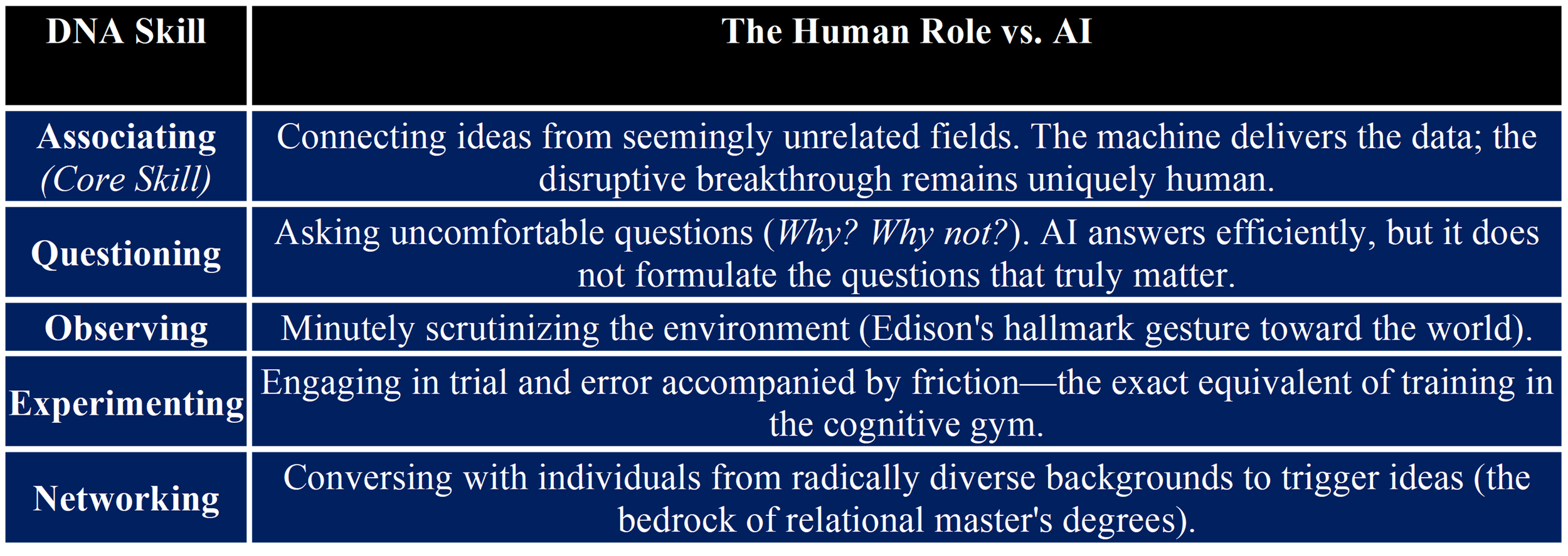
The fact that these five skills remain the most precise roadmap for understanding human competitive advantage over AI proves something vital: the issue has never been technological; it has always been pedagogical and adaptive. We must educate in a way that safeguards the individual's psycho-physical well-being, particularly in an era where human contact is no longer the norm.
BRAVE: Theory Grounded in a Neighborhood Business
Nextwave India, an EdTech platform operating in remote regions of India, offers a practical case study worth examining closely: the BRAVE program (Boosting Revenue through AI Value Engineering). Its logic is simple yet powerful: push students out of their comfort zones and connect them with real small and medium-sized enterprises (SMEs).
By leveraging agentic AI to drastically lower software development costs—something previously cost-prohibitive for small businesses—multidisciplinary teams resolve concrete operational and financial bottlenecks for local merchants. At the end of the process, there is no written exam. Instead, there is a business enjoying better revenue, an SME owner who comprehends their cash flow, and a student who has touched the real world with their own hands. This model perfectly illustrates the Edison approach: AI reduces the cost of building the tool, but value is generated by the human ecosystem that determines its purpose.
How to Create or Sustain Employment in the Age of AI
Returning to the overarching question of this debate: How can economic growth generate or sustain employment and provide opportunities for all generations amidst global demographic shifts?.
The answer, I believe, does not lie in churning out more content or digitalizing curricula in a desperate bid to adapt to job descriptions that were already obsolete before and during the arrival of AI. Those roles were already strained due to the polycrises of the last century, which bred poverty out of social—rather than digital—exclusion.
The real opportunity lies in utilizing artificial intelligence as a foundational infrastructure for accessing information. This liberates human time, allowing us to dedicate it to what no machine can duplicate: accompanying others, questioning, observing our unique environments, and connecting scattered ideas to solve tangible problems. The schools and universities that grasp this ahead of the curve will cease to be credential factories and will transform into agencies for real-world problem-solving.
We must also educate the educators—who are so sorely needed—supported by technologists in an environment conducive to practicing their professions in tandem, ensuring that the learner or apprentice receives the benefit of both combined, rather than in isolation.
The employment of the future will not belong to those who hoard the most certificates, but to those educated under the friction of error: individuals capable of observing their communities, posing uncomfortable questions, and using AI’s value engineering—not as a substitute for effort, but as a lever for it—to make their world more livible. In essence, we need more Thomas Edisons and fewer Swans.
That, and no other, is the true employment infrastructure we are called to build, centered firmly on the student and on the patient they will ultimately treat.
Final Note: As a public health professional, I believe it is vital to understand that education in health promotion and prevention represents the most cost-effective strategy in this digital era. Educational centers must fortify these domains of knowledge to secure a healthier future for the global population.