

From Enabling Innovation to Augmented Human Potential: Intergenerational Work, Global Health and Governance in the Age of Artificial Intelligence
MSc. Víctor Piriz Correa, MD, MPH
Director General — Seniors International Consulting™ (SICs™)
info@seniors-international.com | www.seniors-international.com
World Economic Forum — 17th Annual Meeting of the New Champions | Dalian, China | June 2026
Executive Summary
This article, developed from the perspective of Seniors International Consulting™ (SICs™), examines the intersection of sustainable innovation, labour market transformation and global health governance within the context of the Fourth Industrial Revolution. We contend that innovation is not a binary choice between 'innovate or perish', but rather a systemic imperative: innovate or pay, wherein the costs of inaction — social, economic and sanitary — are borne by society at large. Artificial intelligence (AI) redefines opportunities without eliminating work itself; it transforms competencies and demands intergenerational strategies that bring together young professionals and workers aged fifty-five and above. Talent cannot be consumed without first being created. The Global Lighthouse Network and the global footprint of SICs™ offer a scalable model of transformation. In global health, antimicrobial resistance (AMR), the persistent gap in access to medicines, and the imperative for robust data infrastructure — from the GPU to AI agents — constitute the defining challenges of our era. The human being must always remain in the loop. Technology amplifies human potential; it does not supplant it.
1. Innovate or Pay: Innovation as a Sustainable Enabler
The discourse surrounding innovation has long been dominated by a quasi-Darwinian narrative of urgency: 'innovate or die.' We propose a more precise and more equitable reformulation: innovate or pay. When a healthcare, educational or productive organisation elects not to transform itself, the costs are redistributed onto the public system, onto displaced workers and onto the most vulnerable populations. Innovation thus ceases to be a competitive luxury and becomes a governance obligation.
Within this framework, we advocate for the creation of progressive fiscal schemes that incentivise the transformation of healthcare and essential service enterprises: tax credits for investment in digitalisation, surcharges for demonstrable inaction against international standards, and sectoral funds financed through contributions from those who benefit most from data ecosystems. Sustainable innovation is not a technological sprint; it is a long-term systemic strategy, aligned with the Sustainable Development Goals and with universal health coverage targets.
SICs™ employs the term 'enabling innovation' to denote the ensemble of organisational strategies that create access to work and to opportunity by removing structural barriers before new technologies are introduced. To enable is not to digitalise indiscriminately; it is to prepare the human, institutional and data terrain so that technology takes root with genuine and measurable impact.
2. AI Transforms Opportunities: Skills Adaptation and the New Labour Ecosystem
Artificial intelligence does not destroy work; it reconfigures the opportunities embedded within it. This distinction is critical to preventing unjustified social panic and to designing labour policies that correspond to reality. The International Labour Organisation's report 'Workforce 2030: Skills for Thriving in the Green and Digital Transitions' projects that near-universal broadband coverage could generate approximately 23 million net jobs by 2030, with the greatest gains in medium-skilled occupations — 13 million in the digital sector and 18.5 million in the green transition.(1,2)
Nevertheless, the ILO also cautions that these positions will not materialise automatically. They require active reskilling, genuine social dialogue and lifelong learning. An estimated 22% of positions within enterprises will undergo significant transformation between 2025 and 2030 — a figure that denotes redefinition rather than elimination of tasks, competencies and contexts.(2) The difference between disruption and evolution lies in the quality of preparation.
For SICs™, adapting human resource competencies in the AI era entails, firstly, an honest mapping of existing gaps; secondly, investment in continuous training before those gaps become insurmountable; and thirdly, the design of learning pathways that are neither linear nor uniform, but modular, personalised and formally recognised. Technology enables end-to-end process adjustment, but the steps must first be created: people need to understand the roadmap before they can accelerate.
3. Talent Cannot Be Consumed Without Being Created: The Intergenerational Equation
One of the most costly errors in contemporary management is treating talent as an extractive resource: it is taken, depleted and replaced. In labour markets with high turnover, the hidden cost of losing trained personnel is enormous — estimates from the healthcare sector suggest that replacing a specialist can cost between 100% and 200% of their annual salary, to say nothing of the loss of institutional knowledge.(3)
The OECD's 'Employment Outlook 2025: Navigating the Golden Years' documents that employment rates amongst workers aged fifty-five and above have risen significantly across OECD countries over the past two decades, yet fall sharply beyond the age of sixty, with many workers exiting employment well before reaching statutory retirement age.(3) This premature departure represents a massive forfeiture of experience, mentorship and institutional stability.
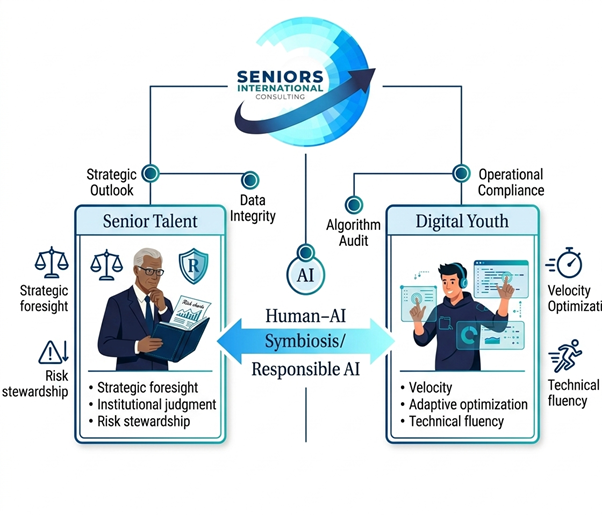
SICs™ advocates an intergenerational workforce model in which young professionals and workers over fifty-five collaborate as complementary peers rather than competing generations. Senior workers contribute depth of judgement, networks of trust and resilience in the face of uncertainty. Young workers bring digital fluency, fresh perspectives and innovative energy. The key is not unidirectional knowledge transfer, but co-creation and mutual learning.
For senior personnel, the most valuable competencies in the digital age are, paradoxically, the most distinctively human: maintaining intellectual curiosity, cultivating the capacity for continuous learning — only one third of adults aged sixty to sixty-five participated in training in 2023, compared with more than half of those aged twenty-five to forty-four(3) — actively promoting inclusion, sustaining team motivation, and building trust and credibility in environments of high uncertainty. The AARP employment barometer of November 2025 confirms that the unemployment rate for workers aged fifty-five and above fell to 3.1% in 2025, signalling that this cohort is highly retained when investment in their adaptation is forthcoming. (4)
4. Beyond the Metropolis: Digital Work, Rural Territories and Meaningful Employment
The digital age offers a historically significant opportunity: to decentralise work away from major urban centres and extend it to rural and peripheral areas. Remote working, cloud services and collaborative platforms allow a consultant in Paysandú, a technician in Ayacucho or a specialist in Oaxaca to engage with global teams without abandoning their communities.
This promise, however, can only be fulfilled through appropriate and robust digital infrastructure. The ILO's 'Workforce 2030' report calculates that a scenario of near-universal broadband access would yield 23 million additional jobs.(2) Without quality connectivity, those opportunities simply will not materialise. Investment in rural digital infrastructure is not expenditure; it is the condition of possibility for territorial equity in the twenty-first century.
Yet infrastructure alone is insufficient. The deeper objective is that work be meaningful rather than routine. Automation ought to liberate individuals from mechanical and repetitive tasks so that they may devote themselves to what algorithms cannot accomplish: generating meaning, building relationships, exercising ethical judgement and caring for others. Work that cannot be entirely tokenised is work that preserves its intrinsic human value.
Attempting to change the world wholesale rarely succeeds. What does succeed is changing oneself — one's own organisations, processes and cultures — with compassionate kindness. This means patiently accompanying those who adopt digital tools more slowly, designing inclusive interfaces, and acknowledging that digital inclusion remains an urgent global priority. Those excluded from the digital sphere do not disappear; they are excluded from fundamental rights.
5. Organisational Governance: Honest Empowerment and the Renewal of Regulatory Frameworks
Transformation without governance is chaos with effective marketing. Governance is not merely a set of rules and procedures; it is the art of creating conditions under which individuals and institutions may achieve their objectives in a sustained, transparent and equitable manner. At SICs™, we regard governance as the vertebral column of any genuine transformation process.
Internally, this begins with equipping middle managers and all staff with knowledge of new organisational objectives and of how the ecosystem has changed. Middle managers are the most critical and most frequently overlooked link in transformation: they absorb pressure from above and resistance from below, without always possessing the knowledge or tools to navigate that tension. Empowering them with substantive training and transparent information is not a luxury of advanced management; it is the minimum condition of effectiveness.
At the normative level, it is time to overhaul rules and frameworks that have gone unreviewed for decades. Many of the labour standards, health regulations and talent management protocols applied today were designed in the post-war period of the twentieth century for an industrial world that no longer exists. Rethinking the way we work requires acknowledging that soft skills — communication, empathy, adaptability, systemic thinking — are today as strategically vital as mastery of any technology.
The transformation of work cannot be the sole responsibility of the private sector, nor of government alone, nor of universities alone. It demands genuine alignment among all three: enterprises that invest in continuous training, governments that update regulatory frameworks and social protection systems, and universities that reorient their curricula towards twenty-first century competencies. Without this triad operating in coordination, transformation will be fragmented, inequitable and ultimately reversible.
6. SICs™ Global Footprint and the Global Lighthouse Network
Seniors International Consulting™ conceives its presence across Latin America — with operations in Mexico, Colombia, Peru, Uruguay and Israel as a laboratory of transformative creativity — as a global footprint guided by the principles of subsidiarity and scalability. Each country operates with a differentiated focus: Mexico as the standard-bearer of quality controls from the outset; Peru as the laboratory for applied innovation; Colombia as the regulatory framework; Uruguay as the platform for institutional creativity; and Israel as inspiration for an entrepreneurial ecosystem.
This architecture aligns with the spirit of the World Economic Forum's Global Lighthouse Network, which in January 2026 welcomed twenty-three new Lighthouses, bringing the community to over two hundred leading production sites worldwide.(5) The most recent cohort of Lighthouses demonstrates, on average, a 40% increase in labour productivity and a 48% reduction in lead times, with AI and generative AI enabling up to 50% of the implemented use cases.(5) The Forum simultaneously launched Lumina, an AI-powered industrial intelligence platform consolidating eight years of Lighthouse Network data.(5)
For SICs™, connecting to the Lighthouse Network ecosystem is not an aspiration of prestige; it is access to standards of operational excellence that can be adapted and transferred to healthcare, education and governance contexts throughout Latin America and the Eastern Mediterranean region. The globally recognised regulatory frameworks emerging from this network raise standards and create a common language of transformation that transcends sectors and borders. We study with particular attention the transformation processes in health and education, where the gaps between what is technologically possible and what is institutionally implemented are greatest and most socially costly.
SICs™ Octopus Theory describes precisely this architecture: a central strategic nucleus — the organisation's intelligence — with autonomous operational arms across different countries and sectors, each with its own sensors yet co-ordinated with the central nervous system. Like the cephalopod, SICs™ can adapt locally with speed whilst retaining global systemic coherence.
7. Global Health: AMR, the Medicines Access Gap and AI as an Accelerator
The heart of the global health challenge in 2026 can be encapsulated in a painful paradox: never before has so much been invested in biomedical research, and yet the gap in access to essential medicines continues to widen. Low- and middle-income countries bear the greatest burden of disease whilst having the least access to the most advanced treatments. This asymmetry is not a market failure that will self-correct; it demands deliberate global public policy intervention.
Antimicrobial Resistance (AMR) is perhaps the most grave illustration of this structural problem. Wellcome Trust projections estimate that AMR will directly cause more than 39 million deaths between 2025 and 2050 — three deaths every minute — and will be an associated factor in a further 169 million deaths.(6) The economic impact is projected to reach losses of between one and 3.4 trillion US dollars annually in global GDP by 2030.(7) Improving access to effective antibiotics could save 92 million lives over the same period.(6)
AMR is fundamentally a problem of sustainable healthcare industry: the antibiotics market fails to attract sufficient private investment because new drugs must be used sparingly to preserve their efficacy, which diminishes commercial profitability. This market failure necessitates public financing mechanisms, outcome-based R&D incentives and open licensing schemes that broaden access without eroding innovation.
How are we to broaden access to medicines in an era where AI is dramatically accelerating their creation? Artificial intelligence now reduces the cycle of new molecule discovery from years to weeks, identifies therapeutic candidates with greater precision and optimises clinical trials. Yet speed of creation without equity of access only deepens the divide. AI must serve more efficient supply chains, more sensitive pharmacovigilance systems and more inclusive financing models. Technology that does not reach the patient who needs it has failed in its fundamental purpose.
8. Data Infrastructure for Intelligent Health: From the GPU to the AI Agent
Building truly intelligent health systems requires robust, layered data infrastructure aligned across three levels: global, regional and local. SICs™ proposes the following framework of progressive architecture:
Layer 1 — Computing Infrastructure (GPU): Without high-performance processing capacity, no healthcare AI model can operate. Investment in GPU and healthcare cloud infrastructure is the physical foundation of everything else.
Layer 2 — Foundational Model and Strategic Objectives: The language or computer vision model must be trained on high-quality biomedical data and aligned with concrete health objectives: early detection, chronic disease management, pharmacovigilance or bed management, amongst others.
Layer 3 — Functional Health Model: A global, regional and local framework of adequate health infrastructure aligned with the impact of the digital age. Initiatives such as Japan's J-MID medical database — which has accumulated over 534 million diagnostic images from ten leading universities(8) — Israel's healthcare big data system, one of the most advanced in FHIR-standard interoperability(9) — and UCLA Health's AI centre of excellence, a benchmark in responsible clinical AI evaluation and implementation(10) — illustrate how a functional model is constructed with rigour and purpose.
Layer 4 — Data Quality Pool: Only high-quality, structured, interoperable and ethically governed data can generate robust evidence. Data quality is not a technical detail; it is the difference between clinical decisions that save lives and those that generate iatrogenic harm or systematic bias.
Layer 5 — Evidence, Automation and AI Agents: A quality data pool generates robust scientific evidence, which in turn feeds progressive automation processes and, ultimately, AI agents capable of learning, adapting and acting under human supervision. The human always in the loop is the guarantee that automation serves health rather than the reverse.
The central question that remains insufficiently answered is whether hospitals are prepared to receive this technology — above all, their human resource teams. Installing software does not suffice; institutional cultures must be transformed, clinical workflows redesigned and health professionals equipped with the digital skills to operate, supervise and interrogate AI systems. The ultimate objective is to create patient-centred, humane healthcare environments in which technology reduces the administrative burden and amplifies the quality of care, with the understanding that the whole of society is immersed in the same wave of digital transformation.
9. SICs™: Productivity, Competitiveness and Future Talent — KPIs and Systemic Framework
For Seniors International Consulting™, sustainability is not a declarative value; it is the condition of survival during the process of building scale. Being simultaneously productive and competitive whilst constructing critical mass is one of the greatest challenges facing any emerging consultancy with global ambitions. SICs™ responds by investing first in internal governance — clear processes, well-defined roles, quality criteria from the outset — before scaling.
From 2026 onwards, SICs™ directs its resources in accordance with a fundamental strategic question: where to invest in order to improve efficacy and efficiency, rather than pursuing each new application that enters the market? The answer lies in three levers: data governance (from human processes to AI agents, step by step), staff empowerment (where do the opportunities lie in their specific field?) and systematic quality control from the very first deliverable.
SICs™ KPIs are structured by time horizon:
Short term (2026–2027): Client satisfaction rate ≥ 90%. Senior consultant retention index ≥ 85%. Projects with formal quality controls from inception: 100%. Continuous training coverage: minimum 40 hours per consultant per annum.
Medium term (2028–2029): Expansion into three new markets with active presence. ISO 14001 certification applied to at least two environmental health projects. AI tools integrated into at least 50% of M&E workflows. Reduction in report delivery time by 30% through assisted automation.
Long term (2030 onwards): Recognition as the benchmark consultancy in global health and data governance across Latin America and MERCOSUR. Network of at least 100 active senior consultants across eight countries. Documented contribution to the training of at least 500 professionals in digital transformation and health governance competencies. Consolidated participation in the Global Lighthouse Network as a reference case for the services sector.
SICs™'s systemic framework invests deliberately in internal and external governance, and in data governance: human processes first, then agents, always step by step. The entire process — from inception to completion, delivering quality data to decision-makers — is the responsibility of the whole team. Technology enables continuous process adjustment and improvement, but only if the steps, the competencies and the incentives for agility are first established.
To tokenise, to flexibilise, to seek efficiency and to build resilience are the four strategic operations SICs™ prioritises in every project: decomposing work into measurable and improvable units, creating service models adaptable to different contexts, eliminating waste and redundancy, and strengthening the capacity for recovery in the face of external disruption. All of this, always with the human being in the loop. AI augments human potential; it does not replace it. Better products for our customers through the augmentation of human potential: that is our lodestar.
10. Conclusion: Learning to Transform with Compassionate Kindness
We emerge from this analysis with a reinforced conviction: success in the AI era is won not through sheer velocity but through systemic wisdom. The challenge is not solely technological; it is profoundly human, institutional and ethical. We need leaders who understand that work is not routine but purpose; that inclusion is not an accessory of transformation but its condition of legitimacy; and that the most powerful technology in the world is of little worth if it does not serve human wellbeing.
At SICs™ we are committed to a learning consultancy: one that learns from every project, every cultural context, every honest failure and every documented success. We are productive, we aspire to competitiveness, and we are building the talent of the future creatively — finding new ways of being senior consultants in a world that changes faster than its own institutions can assimilate.
The world does not change unless we change ourselves. And we change better — more swiftly and more justly — when we do so together: young and over-fifty-five, public and private sectors and universities, global North and global South, early adopters and those who have not yet arrived at the curve. With compassionate kindness for those who proceed more slowly. With rigour for those who make decisions. With enduring curiosity for all.
References
All references cited in the text follow the Vancouver consecutive numbering system.
1. International Labour Organization (ILO). World Employment and Social Outlook: Trends 2025. Geneva: ILO; 2025. Available from: https://www.ilo.org/publications/flagship-reports/world-employment-and-social-outlook-trends-2025
2. International Labour Organization (ILO). Workforce 2030: Skills for Thriving in the Green and Digital Transitions. Geneva: ILO; December 2025. Available from: https://www.ilo.org/sites/default/files/2025-12/Workforce%202030_Web_final.pdf
3. Organisation for Economic Co-operation and Development (OECD). Employment Outlook 2025: Navigating the Golden Years — Making the Labour Market Work for Older Workers. Paris: OECD Publishing; July 2025. DOI: https://doi.org/10.1787/194a947b-en
4. AARP Public Policy Institute. Employment Data Digest: November 2025. Washington DC: AARP; November 2025. Available from: https://www.aarp.org/pri/topics/work-finances-retirement/employers-workforce/employment-data-digest.html
5. World Economic Forum. Global Lighthouse Network Recognises 23 New Sites, Launches AI Platform for Industrial Transformation [Press release]. Geneva: WEF; January 2026. Available from: https://www.weforum.org/press/2026/01/global-lighthouse-network-recognizes-23-new-sites-launches-ai-platform-for-industrial-transformation/
6. Wellcome Trust. New forecasts reveal that 39 million deaths will be directly attributable to bacterial antimicrobial resistance (AMR) between 2025–2050. London: Wellcome; 2024. Available from: https://wellcome.org/insights/articles/new-forecasts-reveal-39-million-deaths-will-be-directly-attributable-bacterial-antimicrobial
7. World Bank. Antimicrobial Resistance (AMR). Washington DC: World Bank; 2025. Available from: https://www.worldbank.org/en/topic/health/brief/antimicrobial-resistance-amr
8. Japan Agency for Medical Research and Development (AMED). Japan-Medical Image Database (J-MID): Medical Big Data Supporting Data Science. Tokyo: AMED; 2024. PubMed Central PMC12257222.
9. Israel Ministry of Health. Digital Health Laws and Regulations: FHIR Interoperability Plan. Tel Aviv: Israel Ministry of Health; 2024. Available from: https://iclg.com/practice-areas/digital-health-laws-and-regulations/israel
10. UCLA Health. UCLA Health Launches Research-Driven Centre of Excellence to Evaluate AI Implementation in Health Care [Press release]. Los Angeles: UCLA Health; 2025. Available from: https://www.uclahealth.org/news/release/ucla-health-launches-research-driven-center-excellence
11. World Economic Forum. Closing the Gender Gap in Senior Leadership 2026. Geneva: WEF; 2026.
12. Piriz Correa V, SICs™ Team. Strengthening the Governance of Health Systems: Why AI Must Not Be a 'Black Box'. White Paper SIC–NI–001–2026. Montevideo: Seniors International Consulting; 2026. Available from: https://www.seniors-international.com
13. International Labour Organization (ILO). World Employment and Social Outlook: May 2025 Update. Geneva: ILO; May 2025. Available from: https://www.ilo.org/sites/default/files/2025-05/WESOUpdate_May2025.pdf
14. World Economic Forum. Global Lighthouse Network: The Mindset Shifts Driving Transformation 2025. Geneva: WEF; 2025. Available from: https://reports.weforum.org/docs/WEF_Global_Lighthouse_Network_2025.pdf
15. Center for Global Development. Forecasting the Fallout from AMR: Economic Impacts of Antimicrobial Resistance in Humans. Washington DC: CGD; 2023. Available from: https://www.cgdev.org/publication/forecasting-fallout-amr-economic-impacts-antimicrobial-resistance-humans
© 2026 Seniors International Consulting™ (SICs™). Article prepared for the World Economic Forum — 17th Annual Meeting of the New Champions, Dalian, China, 23–25 June 2026. Partial reproduction permitted with attribution. | info@seniors-international.com | www.seniors-international.com