

Author: Dr. Victor G. Píriz Correa, Internist, Organization Transformation Manager & CEO of Seniors International Consulting (SIC Global).
The Security in the Era of Policrisis
In the contemporary international arena, security has ceased to be a purely kinetic or reactive construct. As analyzed in post-pandemic strategic governance literature, security must now be conceived as "a system capable of anticipating, cooperating, integrating technology, and exercising ethical leadership" (1). The accelerated digitalization of healthcare architectures, driven by the pursuit of Universal Health Coverage (UHC) and the integration of Artificial Intelligence (AI), has transformed medical records into high-value geopolitical and economic assets. However, this expanded virtual reality broadens the attack surface for advanced cyber threats, exposing critical vulnerabilities in legacy infrastructures that lack robust governance frameworks required to securely operate or monetize clinical data at scale (2).
1. The Global Landscape:
The global deployment of AI in medicine and public health is advancing at an asymmetrical pace relative to institutional oversight capabilities. The global report by the international agency HealthAI demonstrates that while multiple sovereign states have formulated ambitious strategic visions, there remains a "considerable distance between high-level policy ambitions and operational enforcement capacity" (3).
This localized governance deficit not only impedes equitable technological adoption but also opens critical vectors for ransomware incidents, electronic health record exfiltration, and breaches of connected medical devices. Cybersecurity is no longer a peripheral IT department concern; it is a fundamental pillar of institutional stability. Mitigating these systemic risks necessitates a shift toward proactive strategies, including robust incident reporting mechanisms, early-warning systems, and the utilization of controlled environments such as regulatory sandboxes (3).
2. The 2026 Governance Model
To counter systemic technological vulnerability, the operational framework of SIC Global (2026–2028) posits that the digital transformation of healthcare networks must be strictly safeguarded by the principles of data sovereignty and clinical integrity (2). Rather than merely deploying rigid, impersonal infrastructures, the firm's focus centers on addressing the downstream institutional consequences of unprotected information systems.
The firm's strategic plan introduces three core architectural differentiators:
The SIC 2026 Governance Model: A proprietary framework meticulously customized to comply with the complex, evolving healthcare regulations of Latin America and emerging markets. This model mandates quarterly compliance reviews to enforce strict national data sovereignty against foreign extraterritorial laws and overreach (2).
NLP-Driven Semantic Interoperability: Utilizing advanced Natural Language Processing (NLP), SICs' systems restructure and rescue legacy and historical clinical datasets, increasing data utility and availability by 40% without compromising perimeter security boundaries (2).
Mitigating Operational Burden via Cognitive Automation: By embedding intelligent processing layers through the MATIAS™ core engine, the model achieves a 30% reduction in administrative overhead (2). From a security standpoint, this mitigation is vital: by automating routine workflows and eradicating human error at the operational base, the primary entry points for social engineering and phishing attacks are effectively closed.
3. The Specialized Ecosystem (SICs)
International consulting within digital health transformation is fundamentally divided between the methodologies of dominant transnational corporations and highly agile, field-specialized boutiques like Seniors International Consulting, notably demonstrated by their participation in multilateral development bank programs (4,5).
Global market evidence reveals critical methodological discrepancies in securing clinical data, which are synthesized visually in the structural analytical matrix below..
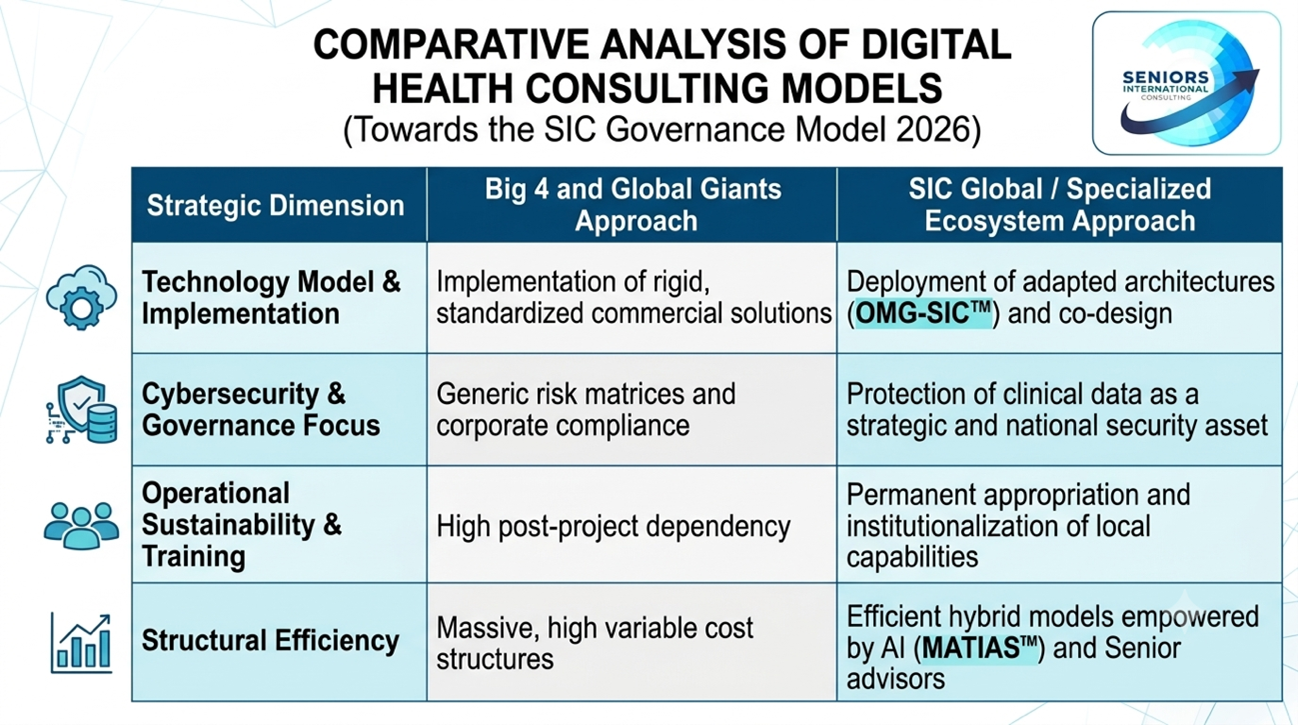
Figure 1: A comparative analysis of Big 4 and SIC Global paradigms within the digital health consulting landscape.
Toward Sovereign Cyber-Resilience in Healthcare
Evidence extracted from global technological ecosystems in 2026 unequivocally demonstrates that healthcare cybersecurity cannot be reduced to the installation of software patches or commercial firewalls. Safeguarding the right to health in an interconnected world demands securing the entire lifecycle of clinical data, framing digital solutions within the sovereign boundaries of each nation state.
While macro-consulting firms and the Big 4 continue to reproduce standardized corporate templates that disregard the institutional pace and specific regulatory realities of developing regions, SIC Global’s specialized boutique model proves that co-design, analytical mitigation of operational errors, and tailored institutional architectures constitute the true vanguard for transforming technological risk into sustainable strategic resilience.
Bibliographic References
Píriz Correa V. Seguridad Global en la Era Pospandemia: Finanzas, Ética y Resiliencia en un Mundo de Policrisis. Montevideo: Seniors International Consulting (SIC); 2026. p. 1-2, 6.
SIC Global. Business Plan: Strategic Institutional Architecture & Digital Health Transformation (Period 2026-2028). Montevideo: SIC Global; 2026. Slide 2, 5-7, 8.
Leal A, Kohan PE, Yap P. AI Governance in Health: Global Landscape. 2025 Report. Geneva: HealthAI - The Global Agency for Responsible AI in Health / CLIAS; 2025 Dec. p. 1-3, 122.
Seniors International Consulting Services (SICS™). Consolidated Curriculum Vitae Package: 30 Expert Consultants | ADB Consultant Management System. Assignment: Build Universal Health Care Program (Subprogram 1) - ADB TA 6832-PHI. Manila/Montevideo: ADB; 2026 Jun. p. 1.
Píriz Correa V. Fundamental Strategic Framework for KOICA Projects: Consulting in Procurement Management and ICT. Initial contributions to Boris’s proposal. Seoul/Montevideo: KOICA; 2026. Section 1-2, 5-6.