

A Key Tool for Complex Decision-Making in International Development Projects
Author: MSc Victor Piriz Correa, MD, MPH — Organization Transformation Manager, Seniors International Consulting (SICs)
Co-Author: Zewar Ghish — Multilingual Specialist in Interpretation, Cultural Mediation, and Migration Programs.
Logical Framework and Definition of a Bayesian Model in Health
The Analytic Hierarchy Process (AHP), developed by Thomas L. Saaty in the 1970s, is a structured method for making complex decisions based on multiple criteria. It allows a problem to be decomposed into a hierarchy of goals, criteria, and alternatives, facilitating pairwise comparisons and assigning quantitative priorities from qualitative judgments. This improves transparency, consistency, and collaboration in decision-making, especially in multidimensional and uncertain contexts. Bayesian models are statistical tools that incorporate prior evidence and update probabilities as new information becomes available. In health, they are used to model uncertainty, support diagnosis, predict events, and optimize clinical and public policy decisions.
Application and Construction of an AHP Model: AHP is based on:
Hierarchical structure: The problem is divided into levels: overall objective, criteria, sub-criteria, and alternatives.
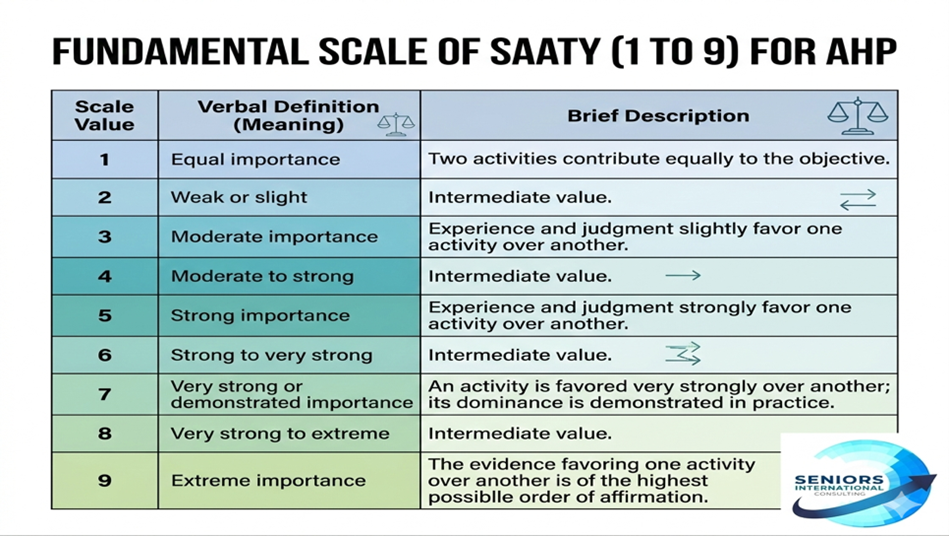
Pairwise comparison: Elements at each level are evaluated two by two using Saaty’s Fundamental Scale to express relative importance.
Priority calculation: Numerical weights are obtained that reflect the relative importance of each criterion or alternative.
Consistency: The coherence of comparisons is checked via the consistency index and consistency ratio.
Saaty’s Fundamental Scale (1 to 9). The AHP operates by structuring the problem hierarchically: first, define the goal or decision to be made, then identify relevant criteria and sub-criteria, and finally evaluate the alternatives. Comparisons are made pairwise using Saaty’s Fundamental Scale, which assigns values from 1 to 9 to express the relative importance between two elements. The result is a weighted ranking that helps prioritize options transparently and collaboratively.
La inclusión o exclusión de alternativas durante el proceso puede alterar las clasificaciones previas, lo que limita la flexibilidad del método.Conflictos y Dependencias Estratégicas
En situaciones con intereses contrapuestos y decisiones interdependientes, AHP puede no ser suficiente, y métodos como la teoría de juegos pueden ser más adecuados.
Nuevos Usos y Aplicaciones de SICs
Priorizar carteras de proyectos: Universidades y organizaciones como la Universidad de Nueva Gales del Sur y el Project Management Institute (PMI) han validado la eficacia de AHP para priorizar proyectos en carteras complejas.
Políticas públicas: El Servicio Civil del Reino Unido y el Banco Mundial utilizan AHP para decisiones transparentes y defendibles en políticas públicas y asignación de recursos.
Ingeniería y planificación: NASA aplica AHP en decisiones de ingeniería y planificación de misiones en entornos de alto riesgo.
Integración con IA y optimización: La investigación continúa combinando AHP con inteligencia artificial y técnicas de optimización para aplicaciones modernas y más robustas.
¿Cuándo Usar AHP?
Cuando hay múltiples criterios en competencia (costos, riesgos, objetivos estratégicos).
Cuando las partes interesadas no están alineadas, ya que AHP fomenta consenso y empatía mediante comparaciones estructuradas.
Cuando los datos son subjetivos o difíciles de cuantificar, AHP ayuda a estructurar y comparar diferentes tipos de datos.
Cuando la toma de decisiones actual es ineficiente, con pérdida de confianza, retrasos o resultados decepcionantes.
Ejemplos de Uso
PMOs y gestión de cartera como en SICs: Priorizar proyectos para optimizar recursos y alinearlos con la estrategia.
Gobierno y políticas públicas: Facilitar decisiones colaborativas y reducir la politización.
Gestión de proyectos e ingeniería: Selección de proveedores, diseño y decisiones críticas.
Estrategia corporativa y finanzas: Integrar factores financieros y no financieros para planificación y presupuesto.
Cómo Empezar con AHP: Cinco Pasos Clave
Construir un modelo de criterios: Definir criterios claros, relevantes y vinculados a objetivos estratégicos, evitando incluir costos o factores no negociables como criterios.
Acordar un conjunto de pesos: Usar comparaciones por pares para establecer ponderaciones, revisando la consistencia y fomentando la alineación del liderazgo.
Puntuar alternativas: Evaluar cada alternativa frente a los criterios usando escalas claras y normalización de datos cuantitativos.
Seleccionar alternativas ganadoras: Analizar puntuaciones finales, clasificar carteras o reducir listas para análisis detallados.
Integrar AHP en el modelo operativo: Usar AHP para gobernanza, gestión de beneficios, control de cambios y transparencia en la toma de decisiones.
Herramientas para AHP
Gratuitas y hojas de cálculo: Útiles para aprender, pero limitadas para carteras grandes o planificación corporativa.
Software especializado (ej. TransparentChoice): Optimiza AHP con funciones avanzadas, colaboración y visualización.
Integración con plataformas PPM: Algunas plataformas incorporan AHP, aunque con limitaciones; la integración con herramientas dedicadas es ideal para decisiones de alta calidad.
Intermediate values (2, 4, 6, 8) allow for nuance in comparisons.
This method is applicable both for portfolio-level prioritization and for decisions within projects, simplifying multidimensional problems and facilitating teamwork. Comparison matrices must adhere to principles of reciprocity, homogeneity, and consistency, assessed by the consistency ratio to ensure coherent decisions. Priority calculation is performed with the eigenvector method, and judgments from multiple participants can be aggregated using geometric or arithmetic means.
Application in Public Health, Networks, Clinical Practice, and Research
3.1 Public Health: At the Centre for Epidemic Research and Modelling (CERM) of the Saw Swee Hock School of Public Health in Singapore, flexible and scalable models — including Bayesian techniques and machine learning — are applied to analyze spatial-temporal epidemic data such as COVID-19, malaria, and HIV. These models enhance epidemiological surveillance and public health decision-making by integrating multiple data sources and criteria.
3.2 The Machine Learning & Global Health Network is an international network that brings together countries and organizations to investigate fundamental problems in machine learning applied to global health. This network promotes interdisciplinary collaboration to develop models that address complex challenges in public health and clinical care, facilitating the transfer of knowledge and technology.
3.3 Daily Clinical Practice In daily clinical practice, machine learning and models such as AHP and Bayesian approaches are used to support diagnosis, treatment prioritization, and resource management. For example, natural language processing (NLP) helps extract relevant information from unstructured clinical texts, improving decision-making and efficiency in healthcare delivery.
3.4 Research in Uruguay, genetic epidemiology integrates genetic and environmental factors to understand the etiology of complex diseases. The use of advanced statistical models, including Bayesian methods, allows identification of high-risk subgroups and improves prevention strategies, contributing to translational health research.
3.5 Global Health Consulting AHP is a structured framework that helps make complex decisions based on multiple criteria. This scale transforms qualitative judgments into quantitative values, facilitating objective evaluation and transparent, collaborative prioritization. Decision-making in organizations, especially in global health and consulting for SICs, faces significant challenges when stakeholders’ priorities differ, data are incomplete, or multiple competing options exist. This can lead to misaligned projects, wasted budgets, frustrated teams, and unattainable strategic goals.
In consulting, Integrated Project Control Systems enable SICs to use AHP to manage multiple projects simultaneously via a master dashboard, such as the “MATIAS” intelligent brain, which helps monitor and align projects with strategic objectives, optimize resource allocation, and improve team coordination.
Benefits
Facilitates structured reflection on criteria and alternatives.
Considers all relevant alternatives and criteria, including qualitative aspects.
Verifies decision consistency to ensure coherence.
Enables prioritization of projects and resource allocation aligned with strategy.
Reduces uncertainty and internal politics in decision-making.
Improves collaboration among multidisciplinary teams and stakeholders.
Application Context In global health, AHP helps prioritize interventions, allocate budgets, and assess risk in complex, dynamic contexts. In consulting for SICs, AHP is essential for aligning projects with strategic objectives, avoiding wasted resources and team frustration. Digital tools and intelligent dashboards enhance the practical application of AHP in real-world settings.
Context and Challenges in the Americas
Monitoring noncommunicable diseases (NCDs) and their modifiable risk factors — such as tobacco use, unhealthy diets, physical inactivity, harmful alcohol use, and air pollution — together with biological factors like obesity, hypertension, and diabetes, enables policymakers to recognize emerging threats and allocate resources efficiently to vulnerable populations.
Between 2000 and 2021, NCD mortality in the Region of the Americas rose to 6 million in 2021, although the age-standardized rate declined by 16.2%, reflecting population growth and aging. However, the annual reduction in premature mortality was insufficient to meet global targets for 2025. Concerning trends are evident in metabolic risks such as hyperglycemia, overweight, and obesity, while tobacco use showed a notable decline. To meet global and regional goals, it is a priority to implement cost-effective interventions that reduce NCD mortality and address these persistent challenges.
The Technological Horizon: Machine Learning and Precision Medicine. Artificial intelligence (AI), and specifically machine learning (ML), has moved from theoretical concepts to the pillars of an unprecedented health reform. In a data-saturated ecosystem, ML acts as a catalyst that transforms raw information into actionable knowledge, optimizing clinical outcomes and system sustainability.
Transformative Applications Across the Clinical Cycle
The deployment of machine learning in contemporary medicine spans from basic research to operational management, highlighting four critical areas:
Advanced Diagnosis and Prediction: By analyzing radiological images and subtle patterns in medical records, ML algorithms can identify pathologies such as neoplasms or cardiovascular disease at subclinical stages, exceeding conventional human detection in speed and precision.
Personalized Medicine: ML enables moving beyond a one-size-fits-all approach. By processing genetic variables, lifestyle factors, and history, clinicians can predict a treatment’s effectiveness, minimize adverse reactions, and adjust dosages dynamically.
Pharmacology and Drug Discovery: Simulation of molecular interactions and analysis of prior clinical trials accelerate the identification of new compounds, drastically reducing development time and costs for essential drugs.
Operational Efficiency: Beyond clinical care, ML optimizes hospital resource allocation, predicts service demand, and automates administrative tasks, allowing healthcare staff to focus on direct patient care.
Success Cases: Leading Startups (EIT Health) The viability of these technologies is reflected in solutions already implemented by leading startups:
BiomeDX: Pioneering use of the gut microbiome to personalize oncologic immunotherapy.
Optellum: Leaders in early lung cancer diagnosis using computer vision.
Idoven and Corify Care: Innovators in cardiology using AI for noninvasive mapping and large-scale remote arrhythmia diagnosis.
Tucuvi and MJN-Neuro: Conversational AI applications for patient follow-up and wearable devices that predict epileptic seizures, restoring patient autonomy.
Genetic Epidemiology Gene-Environment Interaction. An essential component of this new era is Genetic Epidemiology. This discipline studies how hereditary susceptibility interacts with environmental factors (diet, stress, smoking) to trigger complex diseases.
Integrating ML algorithms with Gene-Environment interaction (GxE) studies enables the identification of population subgroups with high genetic risk who are particularly sensitive to specific environmental exposures. This knowledge underpins personalized prevention and precision public health.
Training and the Future: The Case of Uruguay. Continuous updating is imperative. In this context, Uruguay positions itself as a regional reference with initiatives such as the III Latin American Course on Neuroepidemiology (May 2026). This academic event will address advanced methodologies, applied statistics, and genetic epidemiology, focusing on critical challenges such as epilepsy and multiple sclerosis. International collaboration and experience exchange in multicenter networks are fundamental to validating clinical evidence in our region.
Differential Value SICs is a consulting firm at the forefront of integrating advances in AI and statistical modeling to offer strategic solutions to clients in public health, networks, clinical practice, and research. With a professional, ethical, responsible, and evidence-based approach, SICs help align projects with strategic objectives, optimize resources, and improve decision-making in complex, multidimensional environments.
Limits and Restrictions of AHP Use
Independence and Hierarchy AHP assumes that criteria and sub-criteria are independent and that the hierarchy is unidirectional (bottom-up). In practice, interdependencies between criteria often exist, which can oversimplify reality and affect model validity. For such cases, the Analytic Network Process (ANP) generalizes AHP by allowing feedback and interdependence.
Consistency and Preference Scale Saaty’s fundamental scale (1 to 9) is arbitrary and may not adequately reflect relative importance when differences are very large (for example, when one alternative is 25 times more important than another). Also, matrix consistency is crucial; if a threshold is exceeded, weights must be reviewed.
Number of Criteria and Complexity Models: With too many criteria or sub-criteria can generate an excessive number of pairwise comparisons, making the process laborious and prone to inconsistencies. It is recommended to keep between five and nine criteria for a balance between precision and practicality.
Subjectivity and Normalization AHP converts subjective human judgments into numerical values, which can introduce uncertainty. Normalization of preference matrices is only valid if judgments are consistent, and interpretation can be complicated otherwise.
Changes in Alternatives: Including or excluding alternatives during the process can alter previous rankings, limiting the method’s flexibility.
Conflicts and Strategic Dependencies. In situations with opposing interests and interdependent decisions, AHP may be insufficient, and methods such as game theory may be more appropriate.
New Uses and Applications for SICs
Prioritizing project portfolios: Universities and organizations such as the University of New South Wales and the Project Management Institute (PMI) have validated AHP’s effectiveness for prioritizing projects in complex portfolios.
Public policy: The UK Civil Service and the World Bank use AHP for transparent, defensible decision-making and resource allocation.
Engineering and planning: NASA applies AHP in engineering decisions and mission planning in high-risk environments.
Integration with AI and optimization: Research continues to combine AHP with artificial intelligence and optimization techniques for more robust, modern applications.
When to Use AHP?
When multiple competing criteria exist (costs, risks, strategic objectives).
When stakeholders are not aligned, AHP fosters consensus and empathy through structured comparisons.
When data are subjective or hard to quantify, AHP helps structure and compare different data types.
When current decision-making is inefficient, with loss of confidence, delays, or disappointing outcomes.
Examples of Use
PMOs and portfolio management, such as in SICs: Prioritizing projects to optimize resources and align with strategy.
Government and public policy: Facilitating collaborative decisions and reducing politicization.
Project management and engineering: Supplier selection, design, and critical decisions.
Corporate strategy and finance: Integrating financial and nonfinancial factors for planning and budgeting.
How to Start with AHP: Five Key Steps
Build a criteria model: Define clear, relevant criteria linked to strategic objectives, avoiding inclusion of costs or nonnegotiable factors as criteria.
Agree on a set of weights: Use pairwise comparisons to establish weightings, reviewing consistency and promoting leadership alignment.
Score alternatives: Evaluate each alternative against the criteria using clear scales and normalization of quantitative data.
Select winning alternatives: Analyze final scores, rank portfolios, or reduce shortlists for detailed analysis.
Integrate AHP into the operating model: Use AHP for governance, benefits management, change control, and decision-making transparency.
Tools for AHP
Free tools and spreadsheets: Useful for learning but limited for large portfolios or corporate planning.
Specialized software (e.g., Transparent Choice): Optimizes AHP with advanced features, collaboration, and visualization.
Integration with PPM platforms: Some platforms incorporate AHP, though with limitations; integration with dedicated tools is ideal for high-quality decisions.
Toward Evidence-Based Health Governance and the Algorithm. The convergence between the mathematical rigor of the Analytic Hierarchy Process (AHP) and the predictive capacity of Machine Learning (ML) marks the beginning of a new era in global health management. As analyzed, decision-making in complex organizations can no longer rely solely on intuition or one-dimensional financial criteria.
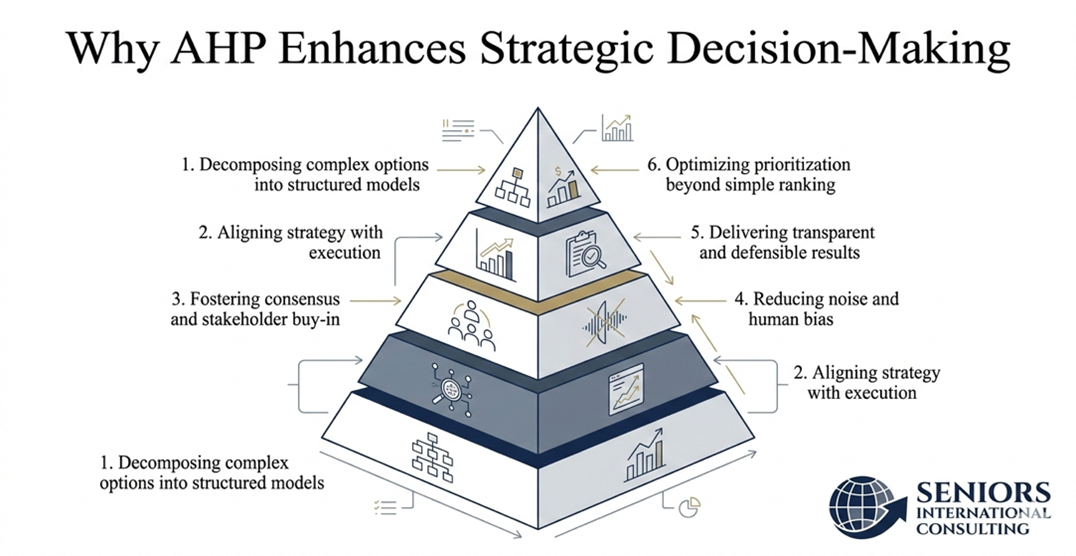
The Synthesis of Strategy and Execution Ricardo Vargas’s work underscores an unavoidable reality: project prioritization is a cognitive process that requires a logical structure to be effective. AHP, by decomposing problems into hierarchies and enabling pairwise comparisons, removes “noise” and human bias, transforming qualitative perceptions into defensible mathematical models. This methodology not only justifies investment in digital health but ensures that every selected project is intrinsically aligned with the organization’s strategic mission.
The Algorithm as a Clinical Ally. Conversely, integrating Machine Learning and Genetic Epidemiology elevates medical practice to an unprecedented level of precision. The ability to identify gene-environment interactions (GxE) and process massive real-time data enables prevention to move from theoretical aspiration to clinical reality. Startups like BiomeDX and Idoven are tangible proof of how ML optimizes everything from oncologic diagnosis to cardiovascular monitoring, reducing costs and improving survival.
In conclusion, the sustainability of health systems and the success of strategic consultancies depend on our capacity to adopt these tools. Using intelligent dashboards — such as the MATIAS system — enhanced by AHP, provides technical and strategic oversight that minimizes resource waste and team frustration.
The future of medicine and public management does not lie in choosing between human judgment and the machine, but in using models like Saaty’s to structure our wisdom and ML algorithms to expand our capabilities. Only through this symbiosis can we face the challenges of an interconnected world and ensure healthcare that is accessible, cost-effective, and, above all, profoundly human.
References
Saaty TL. The Analytic Hierarchy Process: Planning, Priority Setting, Resource Allocation. New York: McGraw-Hill, 1980.
EIT Health. Machine Learning in Healthcare: Uses, Benefits, and Pioneers [Internet]. 2024 [cited 03/04/2026]. Available from: https://eithealth.eu/
National Human Genome Research Institute (NHGRI). Genetic Epidemiology [Internet]. 2023 [cited 03/04/2026]. Available from: https://www.genome.gov/
Universidad de la República. III Curso Latinoamericano de Neuroepidemiología [Internet]. Montevideo: neuroepidemiologia.edu.uy; 2026.
Viana Vargas R. Applying the Analytic Hierarchy Process (AHP) to Select and Prioritize Projects in a Portfolio.
Vargas R. Applying the Analytic Hierarchy Process (AHP) to Select and Prioritize Projects in a Portfolio. Washington DC: PMI Global Congress; 2010. Saaty TL. Relative Measurement and Its Generalization in Decision Making. Rev R Acad Cienc Exactas Fis Nat Ser A Mat. 2008;102(2):251-318.
EIT Health. Machine Learning in Healthcare: Transforming Patient Outcomes [Internet]. Munich: EIT Health e.V.; 2024 [cited 03/04/2026]. Available from: https://eithealth.eu/
Khoury MJ. Genetic Epidemiology. In: National Human Genome Research Institute [Internet]. Bethesda: NHGRI; 2023 [cited 03/04/2026]. Available from: https://www.genome.gov/
Additional resources and links
The Analytic Hierarchy Process (AHP) — Prospectiva y Previsión
AHP: a method to strengthen decision-making in OHS — Preven Control
Analytic Hierarchy Process — Wikipedia
Applying the Analytic Hierarchy Process in healthcare research — PMC
Analytic Hierarchy Process (AHP) — YouTube
Application of AHP for decision-making with expert judgments — SciELO
Application of AHP in digital communication during the pandemic — Revista Latina de Comunicación Social 8–11. (Repeated references to AHP resources listed above)