

Environmental Peace as a Financial Asset: Risk Mitigation in the Era of Global Water Bankruptcy
Introduction
In the global market of 2026, sustainability has ceased to be a mere public relations metric and has become the most critical solvency indicator. At Seniors International Consulting (SICS), we understand that leaders are not primarily concerned with the environment per se, but with the volatility that its degradation imposes on revenues. The Global Water Bankruptcy is not an isolated ecological problem; it is a governance crisis that creates stranded assets and destroys shareholder value.
Our proposal of "Environmental Peace" is essentially a financial stability mechanism designed to safeguard investments and guarantee social license in contexts of high water and social tension, where water becomes a strategic resource and a source of conflict.
The Value of Systemic Governance: The SICS Solar Circle Model
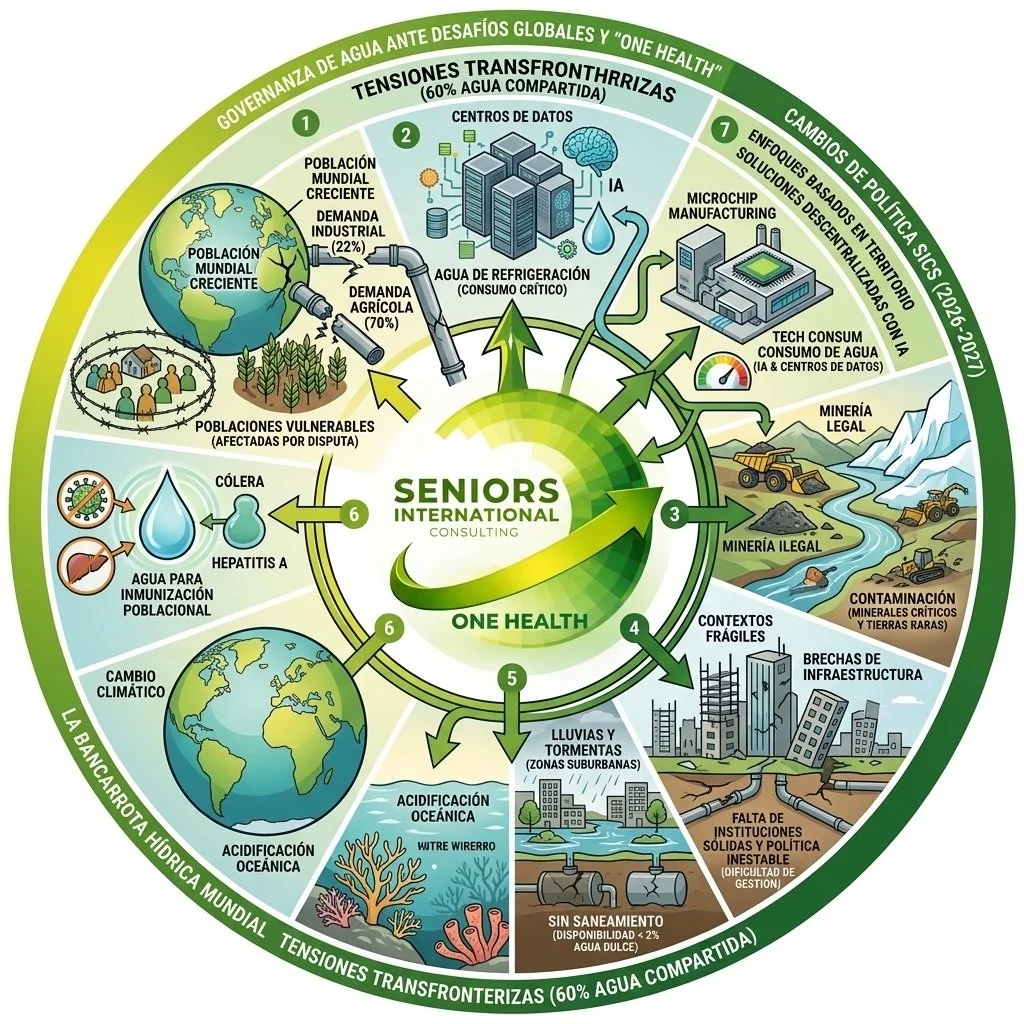
Our strategy’s architecture is visualized in the SICS Solar Circle, which organizes seven critical pressure vectors on water and strategic solutions systemically:
Population competition: 70% agricultural and 22% industrial, intensifying resource disputes.
Technological demand: Cooling for AI and data centers, with high water consumption.
Critical mineral extraction: Lithium and rare earth mining in glaciers and basins, with environmental and social impacts.
Institutional fragility: Weak governance hindering sustainable and equitable management.
Climate change: Less than 2% of freshwater available, affected by extreme events.
Population immunization: Potable water as essential infrastructure to prevent diseases.
Transboundary tensions: Over 60% of freshwater is shared, requiring diplomatic cooperation.
At the core of the model, the One Health approach unifies environmental and human health, ensuring solutions integrate ecosystem and community protection.
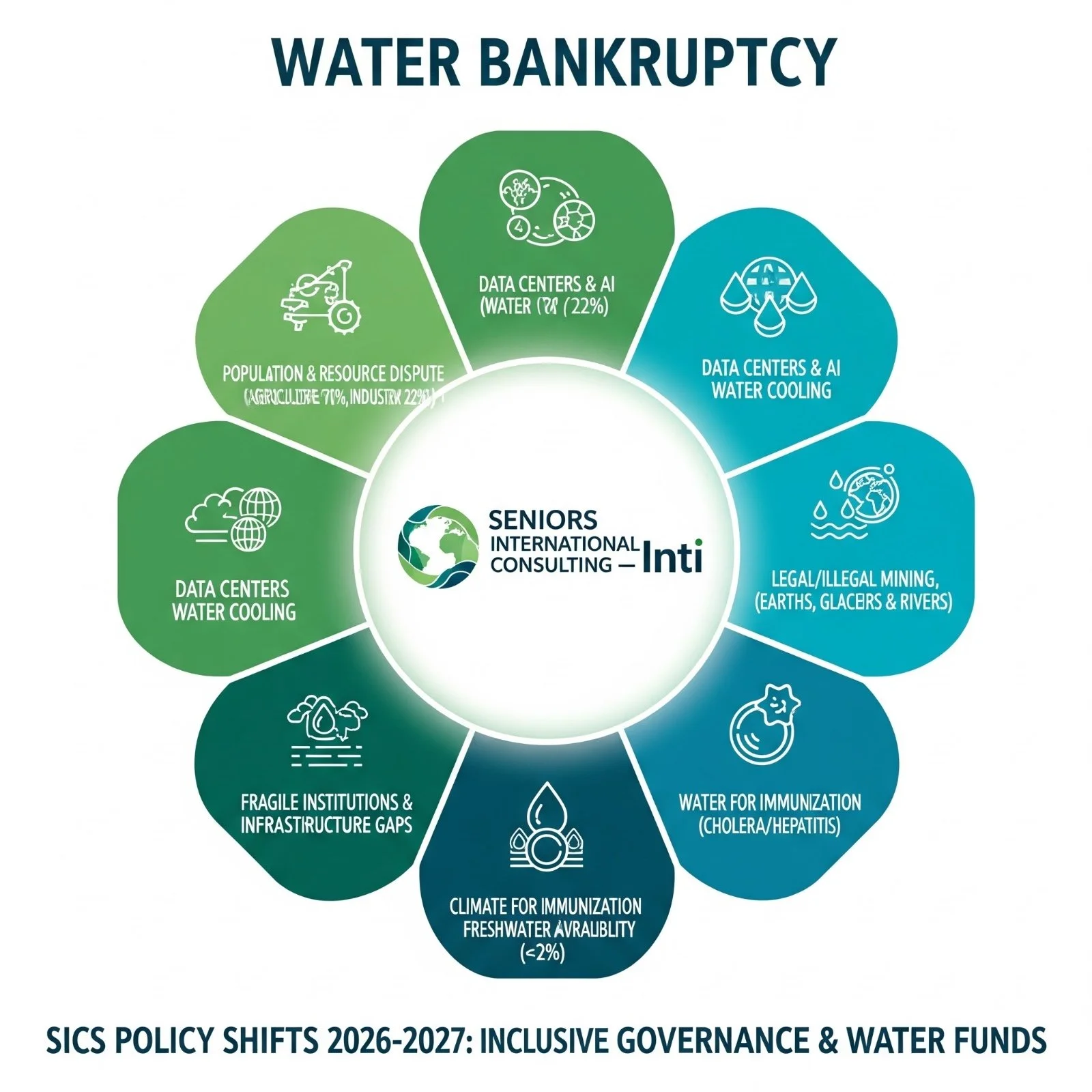
Technical Diplomacy and Water Decoupling
SICS acts as an impartial third party translating social tensions into actionable technical requirements, facilitating technical diplomacy to resolve conflicts in shared basins, especially where lithium mining competes with human consumption.
Through Article 7 of our protocol, we require that at least 60% of water consumed by high-demand industries (mining, data centers) comes from regenerated sources, using advanced technologies such as:
DAF (Dissolved Air Flotation)
MBR (Membrane Bioreactors)
This reduces pressure on freshwater sources and mitigates political and social risks.
ESG Guarantee for Investors and Water Funds
For multilateral banks, green funds, global consultancies (including the Big4), pharmaceutical companies, universities, and governments, the SICS Solar Circle becomes the definitive metric to assess risks and opportunities in water and mining management.
ESG stands for Environmental, Social, and Governance, a set of key criteria investors use to evaluate the sustainability and ethical impact of their investments.
Our proposal ensures investments meet the highest ESG standards, guaranteeing:
Environmental Security: Protection and sustainable use of water resources, minimizing negative impacts on ecosystems and biodiversity.
Social Responsibility: Respect for local communities, human rights, equity, and citizen participation in water and natural resource management.
Transparent Governance: Strong institutions, regulatory compliance, business ethics, and effective accountability mechanisms.
By reinvesting operational savings derived from water reuse through advanced technologies (DAF and MBR) into Water Funds, we ensure the five dimensions of water security demanded by regulators and responsible markets:
Domestic Security: Guaranteeing access to potable water for the population.
Economic Security: Protecting the continuity and profitability of industrial and mining operations.
Urban Security: Preserving infrastructure and quality of life in urban areas.
Environmental Security: Maintaining the integrity of ecosystems and natural sources.
Climate Security: Adapting and mitigating climate change impacts on water availability and quality.
This approach turns the water crisis into an opportunity to safeguard investments, guarantee social license, and generate sustainable financial value aligned with regulatory demands and global market expectations.
Conclusion: From Crisis to Ethical Abundance
The era of cheap water and ignored risk is over. In fragile environments, water is used as a weapon or a trigger for public health catastrophes, multiplying the likelihood of operational failure.
SICS’s resolution is strategic: we transform the environmental crisis into capital efficiency and ethical leadership. We do not manage scarcity; we design abundance through ethical and systemic governance that ensures return on investment and social resilience.
Strategic Bibliography (Vancouver Style)
Seniors International Consulting. SICS Strategic Protocol for Critical Minerals: Mining, Water, and One Health. Lima: SICS Publishing; 2025.
World Bank Group. Water-Smart Mining: Strategic Framework for the 2030 Agenda. Washington D.C.: World Bank Group; 2024.
Inter-American Development Bank. Socio-Environmental Conflict Resolution in the Lithium Triangle. Washington D.C.: IDB; 2025.
Lloyd Mexicano. Technical Classification and Potential for Wastewater Reuse. Mexico City: LM; 2025.
Aquae Foundation. Strategic Management and Desalination: Models from Singapore and Las Vegas. Madrid: Aquae Foundation; 2025.
United Nations University Institute for Water, Environment and Health (UNU-INWEH). Global Water Bankruptcy: Living Beyond Our Hydrological Means in the Post-Crisis Era. Hamilton, Canada: UNU-INWEH; 2026.
CSR Consulting. Global Water Bankruptcy: The New Water Reality According to the UN [Internet]. 2026 [cited 2026 Mar 13]. Available from: https://www.csrconsulting.com.mx/ecologia/bancarrota-hidrica-global-la-nueva-realidad-del-agua-segun-la-onu/
United Nations Development Programme. Paving the way for sustainable finance in Latin America and the Caribbean [Internet]. 2023 [cited 2026 Mar 13]. Available from: https://www.undp.org/latin-america/press-releases/paving-way-sustainable-finance-latin-america-and-caribbean