

The Trust Deficit in Global Health Governance
From Policy Intent to Operational Resilience
By Seniors International Consultancy Services (SICs)
The next major crisis engulfing healthcare systems will not merely be fiscal, technological, or epidemiological. It will be a crisis of trust.
Global health is currently navigating an era of polycrisis. Concurrent conflicts, human displacement, fiscal constriction, climate transition, institutional fragmentation, digital transformation, and artificial intelligence are radically rewriting the rules of healthcare governance. Within this new paradigm, multilateral development banks, bilateral development agencies, green funds, sovereign governments, and pharmaceutical corporations are confronted with a singular, overriding question: Whom can we trust to design, finance, and implement health systems that are technically sound, socially legitimate, and operationally resilient?
The question appears deceptively simple, yet it is profoundly complex. In the health sector, trust is not a decorative virtue; it is a strict, non-negotiable operational prerequisite of the system.
Health systems are inherently relational (1). Consequently, many of the most critical challenges they encounter are not merely technical, financial, or administrative bottle-necks, but rather deeply entrenched issues of human relations, behavioral dynamics, and systemic trust (1). Nonetheless, the disciplinary perspectives that have historically underpinned health policy analysis offer a constrained and partial understanding of human behavior and stakeholder interactions (1). The healthcare sector has much to learn from broader sociological and behavioral literature regarding the multifaceted factors that govern human cooperation (1).
In this regard, Lucy Gilson’s seminal research scrutinizes what debates surrounding trust can contribute to health policy analysis, meticulously exploring its conceptual meaning, foundational structural bases, and tangible systemic outcomes within healthcare institutions (1). A pivotal element of these debates, particularly concerning social capital, is trust and its capacity to catalyze collective action—that is, sustained cooperation between individuals and institutions to achieve shared societal objectives (1).
Source: Investigation Lucy Gilson: “Trust and the development of health care as a social institution”
The unique significance of trust lies in its capacity to offer a robust alternative to the economic individualism that has monopolized public policy analysis for decades (1). Gilson firmly contends that trust sustains the internal cooperation within health systems—a cooperation that is strictly indispensable for the actual production of health (1). Furthermore, she posits that a health system anchored in trust functions as a major catalyst for building public value and social cohesion (1). Bereft of it, individual actors default to self-preservation, institutional friction skyrockets, and structural innovation loses all socio-political legitimacy.
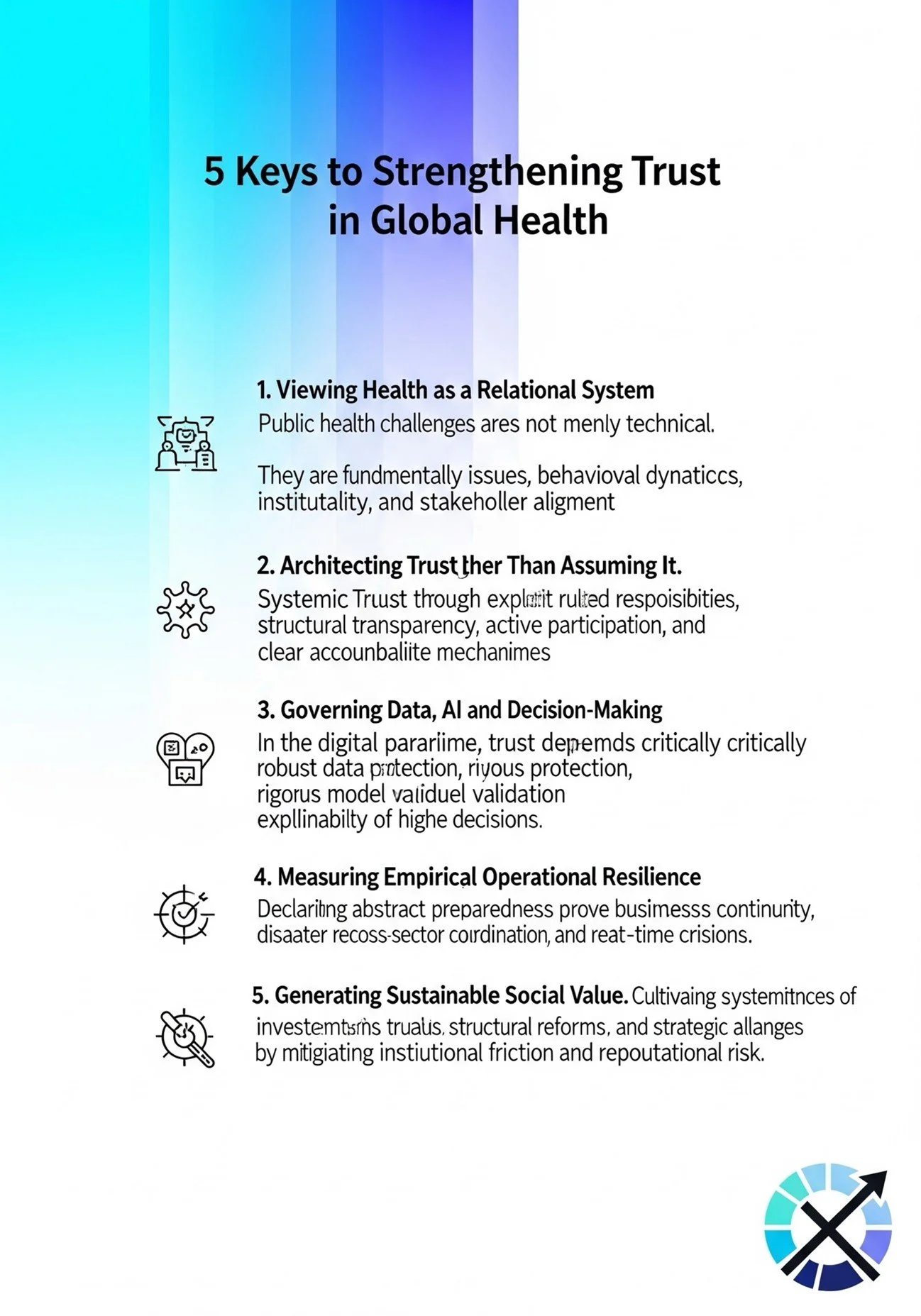
In the contemporary context, however, this conceptualization must be expanded and mandatorily translated into actionable management frameworks. Public health trust is no longer bartered solely within the traditional clinical encounter or through the mere existence of codified, formal policies. Today, systemic trust depends critically upon robust data governance, the responsible deployment of AI, operational business continuity, demonstrable crisis-recovery capabilities, and radical transparency in high-stakes decision-making.
In other words: trust must be designed, governed, measured, and proven under pressure.
The Paradox of Perception vs. Empirical Resilience
The global findings from the Data Trust and Resilience Report published by Veeam expose an alarming paradox that should deeply disquiet the healthcare ecosystem: 90% of surveyed executive leaders express absolute confidence in their organizations’ preparedness and recovery metrics. Yet, empirical outcomes reveal a severe operational chasm. Among entities that experienced disruptions over the preceding 12 months, 42% reported severe service outages affecting patients or constituents, and 41% suffered direct financial impacts. In critical ransomware incidents, a mere 28% of organizations succeeded in recovering the entirety of their compromised data assets.
Table 1. The Healthcare Resilience Paradox

The conclusion is stark: perceiving oneself as prepared is mathematically distinct from demonstrating verifiable recovery capabilities. When a health system suffers a structural failure, the fallout is simultaneously clinical, social, ethical, and political. An operational interruption in healthcare translates immediately to disrupted treatment regimens, delayed diagnostic windows, the exposure of highly sensitive biometric data, or systemic failures in epidemiological surveillance within highly vulnerable populations. For this reason, resilience cannot remain an abstract promise; it must manifest as a rigorously audited, empirically proven capability.
Artificial Intelligence Broadens the Chasm
Artificial Intelligence is rapidly transitioning from theoretical experimentation to baseline execution in population health management, resource allocation, and diagnostic systems. However, it simultaneously introduces unprecedented vectors of governance risk and visibility deficits. Current metrics indicate that 43% of institutional health organizations admit that their adoption rate of AI tools vastly outstrips their internal capacity to protect sensitive data assets and the analytical models themselves. Concurrently, 42% acknowledge a severe lack of internal visibility regarding the algorithms and models currently deployed across their enterprise.
AI does not merely process data; it actively conditions choices that impact human lives and sovereign fiscal budgets. Consequently, institutional clients and international agencies are no longer merely asking if a technological paradigm is innovative. They demand to know: Is it legally defendable, strictly governable, fully auditable, ethically legitimate, and operationally resilient?
A large cohort of organizations erroneously responds by drafting abstract policy statements or ethical manifestos that fail to mitigate real-world risk because they lack enforceable controls and transparent ownership metrics. Treating digital transformation, bioethics, and healthcare resilience as isolated silos separated by organizational charts or ministerial barriers is a critical, systemic error. Contemporary governance mandates cross-functional architectures, starkly contrasting the current reality where a mere 17% of entities possess a unified decision-making structure bridging executive boards, bioethics committees, and data science teams.
From Trust as a Value to Trust as an Operational Capability
The paramount challenge confronting development banks, sovereign governments, and technical partners extends far beyond financing or designing health projects using archaic, linear administrative frameworks. The true imperative lies in guaranteeing that these systems remain completely reliable during systemic shocks, soundly transcending analytical individualism.
To take trust seriously, the global health sector must adopt an advanced paradigm of policy analysis and execution. At Seniors International Consultancy Services (SICs), we address this structural gap through a proprietary architecture centered on systemic trust and institutional governance. Specialized methodological frameworks—such as OMG-SIC™, Sistema Matías™, and the Árbol Institucional—enable us to map stakeholders, accountabilities, vulnerabilities, data lineages, and critical decision-making nodes with mathematical precision. Our overarching objective is to transmute health trust from a fluid aspiration into an operationalized asset: rigorously designed, transparently governed, systematically measured, and empirically tested.
In an era of global polycrisis, trust cannot be improvised, nor can it be left to the mercy of reductionist, linear management theories. It must be engineered prior to the crisis, validated continuously throughout operations, and robustly sustained when the system is subjected to maximum stress.
References
Gilson L. Trust and the development of health care as a social institution. Soc Sci Med. 2003;56(7):1453-68.
Veeam. Data Trust and Resilience Report 2026: Executive perspectives on digital transformation, AI governance, and operational recovery. Columbus (OH): Veeam Publications; 2026.