

Reimagining the Abyss: Why Blue Finance and Ocean AI Are the Next Frontier in Global Healthcare and Financial Consulting
By: Global Strategy Team at Seniors International Consulting (SICs)
Lead Researcher: MSc Victor Piriz Correa MD, MPH
Published in the framework of World Oceans Day 2026 and ahead of the imminent release of the United Nations' Third World Ocean Assessment (WOA III).
The theme for World Oceans Day 2026, "Reimagine," places us before an uncomfortable mirror. The ocean covers more than 70% of the planet, captures 90% of anthropogenic excess heat, and generates half of the oxygen we breathe. However, the scientific consensus compiled in the UN’s preliminary WOA III report issues an unequivocal warning: the window to mitigate systemic changes in the hydrosphere is closing due to cumulative pressures and unprecedented thermal tipping points.
For the institutions that drive the global economy—the World Bank Group, the IDB, Green Funds, pharmaceutical corporations, and local governments—this diagnosis is no longer a strictly ecological issue. It is an operational, financial, and public health risk of macroeconomic proportions.
One year after the milestones achieved in the Nice Ocean Action Plan during the Third UN Ocean Conference (UNOC3 2025)—where the European Commission committed €1 billion and the High Seas Treaty (BBNJ) was accelerated—the question for decision-makers is not why to act, but with whom to design the solutions. This is where the convergence between data science, environmental risk management, and global health infrastructure becomes critical.
1. The UN Critical Diagnosis (Towards WOA III) and Cryosphere Dynamics
The preliminary summary of the Third World Ocean Assessment (WOA III), drafted by more than 590 global experts, confirms that the pace of climate change on decadal scales is determined by macro-scale absorption processes occurring in polar latitudes.
Core scientific contributions, aligned with research from the CNRS and the IPCC, break down this internal ecosystem degradation into three axes:
Thermal Tipping Points and Stratification: The warming of the upper layers consolidates summer marine stratification. Rising temperatures and fresh water input from melting ice reduce surface density, hindering vertical mixing and threatening to slow down the thermohaline circulation (the Great Ocean Conveyor Belt).
Cascading Synergistic Effects: The combination of acidification, overfishing (90% of large fish stocks are already depleted), and microplastic pollution—detected from the surface to the Mariana Trench—generates combined impacts that traditional statistical models fail to predict.
The Southern Ocean as a Connecting Axis: This region drives the upwelling of deep waters that absorb carbon and undergo subduction into the abyssal interior. A slowdown of these sinks would precipitate an irreversible global climate contingency.
Scientific Nuance: The summer disappearance of sea ice does not intrinsically constitute an irreversible point of no return. If emissions are drastically mitigated, ice exhibits thermal resilience for its recomposition; however, its temporary absence exacerbates the albedo effect, accelerating ice melt in continental masses like Greenland.
2. Risk Management via Artificial Intelligence in the Marine Domain
To bridge the monitoring deficit identified by the UN, AI has transformed into the core of environmental risk management and preventive decision-making:
Satellite Surveillance and the Fight Against IUU Fishing
Through Deep Learning algorithms applied to Synthetic Aperture Radar (SAR) satellite imagery and optical data, platforms like the Open Ocean Project successfully identify "ghost ships" (vessels that intentionally turn off their Automatic Identification Systems - AIS), reducing illegal activities in ocean hotspots by up to 25%.
Ecosystem Modeling and Resilience
Machine learning models outperform the resolution of classical climate systems:
Coral Bleaching Prediction: They map 98% of shallow reefs, crossing thermal micro-variations to issue early warnings. This is critical considering that 50% of the world's coral reefs have already been destroyed.
Pollutant Dynamics: They simulate marine currents with changing thermohaline variables to intercept tons of plastic waste at river mouths before they disperse into the open sea.
The Acoustic Challenge and Bioacoustics
Through automated analysis with underwater hydrophones, AI processes thousands of hours of subaquatic audio. This allows for the assessment of anthropogenic noise pollution levels from commercial maritime traffic, mitigating collision risks and disorientation in cetacean migration.
3. Challenges and Governance of AI Itself: Data Bias
Scientific literature raises a severe warning regarding data bias and global inequity. Most algorithms are trained on data from the Northern Hemisphere or developed zones. Small Island Developing States (SIDS), which suffer the worst ocean impacts, lack the technological infrastructure to deploy or audit these automated systems. AI is an indispensable catalyst, but its real success will depend on tools being integrated in an open, ethical, and equitable manner.
4. UNOC3 Nice 2025 Balance: Achievements and Geopolitical Frictions
The Third United Nations Ocean Conference, held in Nice, France, from June 9 to 13, 2025, gathered over 15,000 attendees and 60 Heads of State under the political declaration "Our Ocean, Our Future: United for Urgent Action."
El Balance de Acuerdos y Tensiones
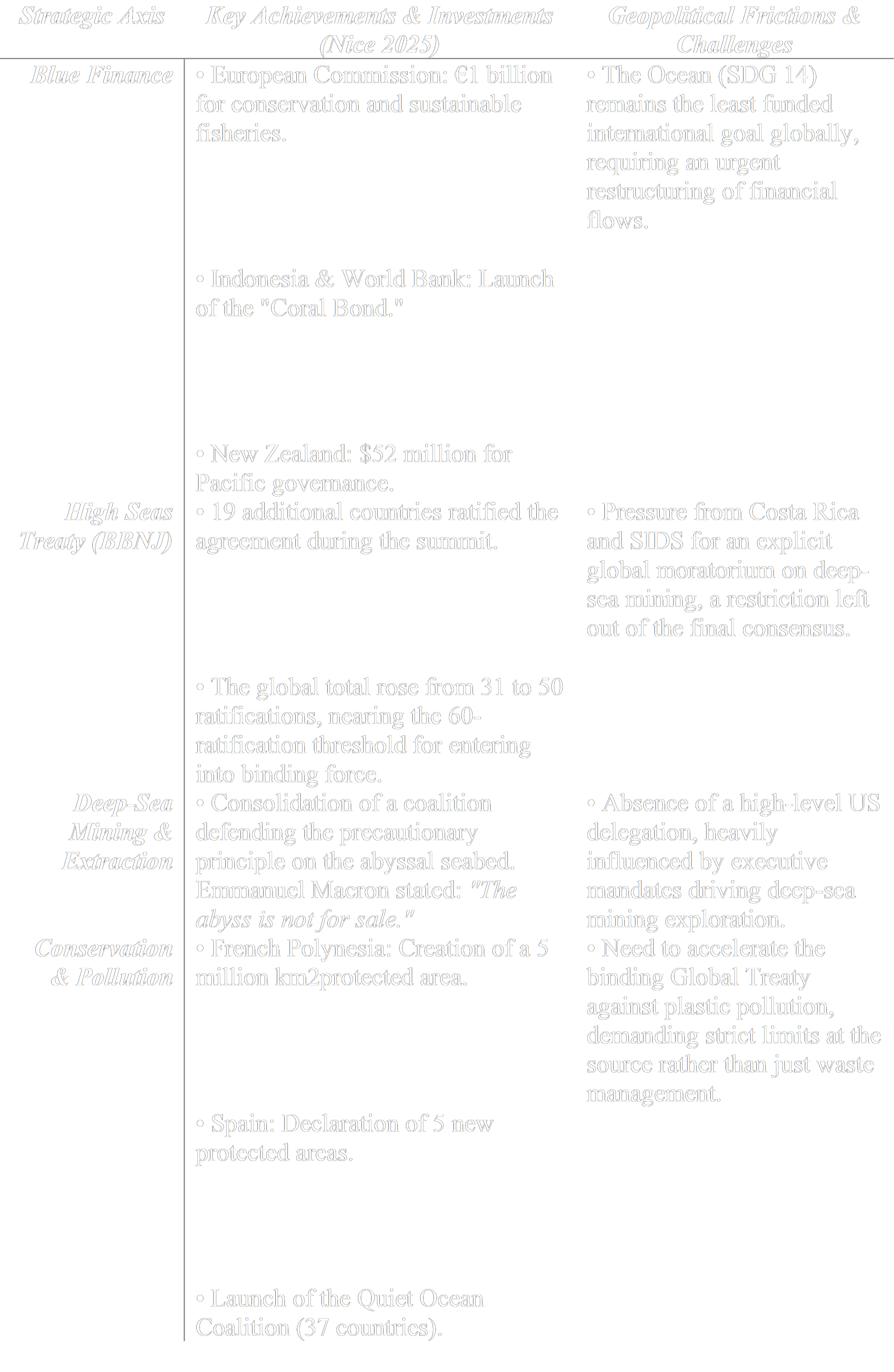
The summit concluded by legally linking its political goals to the Kunming-Montreal Global Biodiversity Framework, consolidating the global target to protect 30% of marine ecosystems by 2030 (30x30 Target). The roadmap now shifts focus to UNOC4, to be co-hosted by Chile and South Korea in 2028.
5. The One Health Approach: Operationalizing the Ocean-Health Interconnection
At Seniors International Consulting (SICs), we understand that the degradation of the hydrosphere—manifested in thermal tipping points, deoxygenation, and the disruption of thermohaline circulation—directly and multisystemically impacts human health. We cannot protect human beings if we ignore the heartbeat of the ocean.
Addressing health risks derived from marine ecosystem changes through telemedicine, digital mental health, and Artificial Intelligence means operationalizing the One Health approach at the frontier of climate innovation. This is precisely the type of high-complexity project our institutional clients demand following the Nice Summit agreements.
We transform macro-political commitments and high-impact scientific metrics into corporate governance tools through three strategic pillars:
Financial Engineering and Singular Blue Bonds: We assist multilateral banks and development funds in structuring debt-for-nature swaps with real impact metrics, ensuring that capital translates into effective protection under the Kunming-Montreal framework.
Unbiased AI Governance and Open Data: We develop and audit predictive deep learning models applied to ocean health, ensuring that local and regional governments in the Southern Hemisphere possess data sovereignty.
Global & Interconnected Health (Climate Telemedicine): We connect the dots between marine ecosystem degradation, the loss of food security for over a billion people, and the psychosocial stress of vulnerable coastal communities, designing digital health networks prepared for climate adaptation.
Strategic Alliance Call: Co-Designing Our Collective Future
The Big 4 and government agencies require specialized allies who master both the language of the United Nations and the analytical rigor of AI applied to marine and health sciences.
If your organization seeks to implement telemedicine solutions and health risk management frameworks derived from marine ecosystem changes, we invite you to define the initial scope through our strategic framing structure:
Strategic Framing Form for Alliances (SICs)
1. Partner Profile and Institutional Ecosystem
Entity Type: Do you represent a financial institution (e.g., IDB, World Bank, Green Climate Fund), a bilateral development agency (e.g., AFD), a local/regional government, a pharmaceutical corporation, or an academic institution?
Core Capabilities: What is the primary strength your organization brings to this alliance? (e.g., Funding capacity, on-the-ground infrastructure deployment, software development, or access to oceanographic data).
2. Dimension of the Health Risk to Mitigate Which critical areas of the ocean-health intersection will the intervention focus on?
[ ] Climate Epidemiology: Monitoring and remote medical care for outbreaks of waterborne pathogens or vectors accelerated by ocean warming (e.g., harmful algal blooms / red tides).
[ ] Food Security and Nutrition: Preventive telemedicine platforms for coastal communities whose access to marine proteins has collapsed due to overexploitation or ocean stratification.
[ ] Digital Mental Health and Resilience: Remote psychological support and post-traumatic stress management in populations displaced or economically affected by sea-level rise and extreme weather events.
3. Geographical and Technological Delimitation
Target Region: What priority geographic area have you identified for the pilot project? (e.g., Small Island Developing States (SIDS), coastal zones of Latin America and the Caribbean).
Technological Synergy: Do you have proprietary AI models, marine sensors, or satellite data that need to be integrated via APIs with the digital health solutions we will co-design?
World Oceans Day is not a day for passive reflection; it is the beginning of the fiscal year for resilience. We invite financial entities, pharmaceutical companies, and global leaders to transition from mere beneficiaries to true strategic guardians. The future is managed today.
Bibliography
CLIM. Thermohaline Circulation Explained by Oceanographer Jean-Baptiste Sallée [Video]. YouTube; 2023 [consultado el 8 de junio de 2026]. Disponible en: https://www.youtube.com/watch?v=IP5n3g9zZ9Q
United Nations. The Third World Ocean Assessment (WOA III): Pre-publication Draft Summary. New York: United Nations Division for Ocean Affairs and the Law of the Sea; 2025.
Sallée JB, Abrahamsen EP, Allaigre C, Auger M, Ayres H, Badhe R, et al. Southern ocean carbon and heat impact on climate: the SO-CHIC consortium. Phil Trans R Soc A. 2023;381(2249):20220056. Available from: https://doi.org/10.1098/rsta.2022.0056
Li A. Navigating the frontier of data openness: the obligation to cooperate in marine climate data governance under the AI Era. Front Mar Sci. 2026;13:1830559. Available from: https://doi.org/10.3389/fmars.2026.1830559
Li D. Artificial intelligence, capability transformation, and marine green development: empirical evidence from Coastal China. Front Mar Sci. 2026;13:1816756. Available from: https://doi.org/10.3389/fmars.2026.1816756
Intergovernmental Panel on Climate Change (IPCC). Special Report on the Ocean and Cryosphere in a Changing Climate (SROCC). Pörtner HO, Roberts DC, Masson-Delmotte V, Zhai P, Tignor M, Poloczanska E, editors. Cambridge: Cambridge University Press; 2022.
Luo JJ. AI for atmosphere–ocean sciences: advancements, challenges and ways forward. Nat Comput Sci [Internet]. 2025 [cited 2026 Jun 8];5(3):142-155. Available from: https://pmc.ncbi.nlm.nih.gov/articles/PMC12976684/
National Geographic Society. Special Report: The State of Our Oceans and Artificial Intelligence Solutions. National Geographic Magazine [Internet]. 2024 [cited 2026 Jun 8];(Special Issue). Available from: https://www.nationalgeographic.com/environment