

From the Global South: Artificial Intelligence, Earth Overshoot Day and the Case for ‘One Health’ Infrastructure
By: Seniors International Consulting (SICS)
Focus: Development Geopolitics, Environmental Health (One Health) and Decarbonisation in LAC
“Progress without harm: technological innovation cannot advance at the expense of the planet’s biological budget, nor of our communities’ health. Latin America must not become the environmental liability of global technological development.”
On 30 July 2026, humanity exhausted the planet’s ecological budget for the entire year. From that date onwards — Earth Overshoot Day — we have, quite literally, been living on credit.
That is the verdict of Global Footprint Network, the organisation that has calculated this date annually since 2003 together with the University of York and FoDaFo (Footprint Data Foundation)[1]. Overshoot Day marks the moment at which human demand for renewable resources and ecosystem services — food, timber, fibre, carbon absorption, land for infrastructure — exceeds what the planet’s ecosystems can regenerate within that same year[1,28]. From that day until 31 December, humanity operates in ecological deficit: it draws down the natural capital of future generations, not merely their interest.
In 2026, that deficit has reached an unprecedented level: humanity is using nature’s resources 73% faster than they can be replenished, the equivalent of 1.73 Earths[1]. It is the highest level of overshoot ever recorded, arriving nearly five months before the calendar year ends. At Seniors International Consulting (SICS), we believe this figure should concern a health ministry every bit as much as a development bank: overshoot is not an environmental abstraction, it is a leading indicator of economic, health and investment risk. This article develops that thesis across three dimensions: the origins of the ecological debt, its deeply unequal distribution across Latin America and the Caribbean, and the region’s most concrete and urgent case today — the expansion of artificial intelligence and data centres across Mercosur — as proof that innovation is only genuine progress when it is governed without doing harm.
A debt that has gone unpaid for 55 years
The Ecological Footprint — the metric behind Overshoot Day — is today the most comprehensive system of biological resource accounting in existence: it is built on more than 15,000 data points per country, per year[1]. Since Mathis Wackernagel and William Rees first formulated it in 1995, its central finding has not changed, only worsened: in 1995 humanity was consuming the equivalent of 1.3 planets[2]; thirty years later, it consumes 1.73[1]. “We are stretching the limits of how much ecological damage we can afford (...) we owe the planet at least 20 years of ecological regeneration, even if we stopped all further damage now,” warns Dr Lewis Akenji, a board member of Global Footprint Network[1]. Indeed, the ecological debt accumulated since the onset of global overshoot in the early 1970s is now equivalent to 20.6 years of the planet’s full biological productivity[1].
Where does this debt come from? 61% of humanity’s Ecological Footprint corresponds to its carbon footprint: emissions from burning oil, gas and coal[1]. It is by far the largest component, and also the most malleable. According to Global Footprint Network’s own calculations, halving global fossil CO2 emissions would push Overshoot Day back three months[1]. No other lever available — reforestation, dietary change, reducing food waste — has, on its own, a comparable effect[3]. The implication for public policy and investment is direct: the energy transition is not one option among several equally valid ones; it is the one that closes the gap fastest.
"Overshoot cannot last. It will end either by deliberate design or by imposed disaster. It should not be difficult to choose which is preferable." [1] — Dr Mathis Wackernagel, Global Footprint Network
This is not a discussion that remains merely symbolic. The concentration of greenhouse gases in the atmosphere rose from 367 parts per million of CO2-equivalent in 1972 — when global overshoot began — to 547 ppm in 2026, according to NOAA estimates[4]. The IPCC, in its Sixth Assessment Report Synthesis Report, concludes unambiguously that human activity is the principal cause of this warming[5]. That is the measurable physical counterpart of five decades of living beyond the planet’s means: more extreme weather events, more soil erosion, more biodiversity loss and, consequently, less food and health security for the most exposed populations.
The Latin American paradox: those who spend least, pay most
Overshoot Day is not the same for every country, and that inequality is the second pillar SICS wishes to place on the table. Qatar exhausted its ecological budget on 4 February 2026; Luxembourg, on 17 February[6]. At the other extreme, countries with far smaller footprints reach their own overshoot almost at the year’s close. The correlation is clear: the higher the income and per-capita consumption, the earlier the date falls.
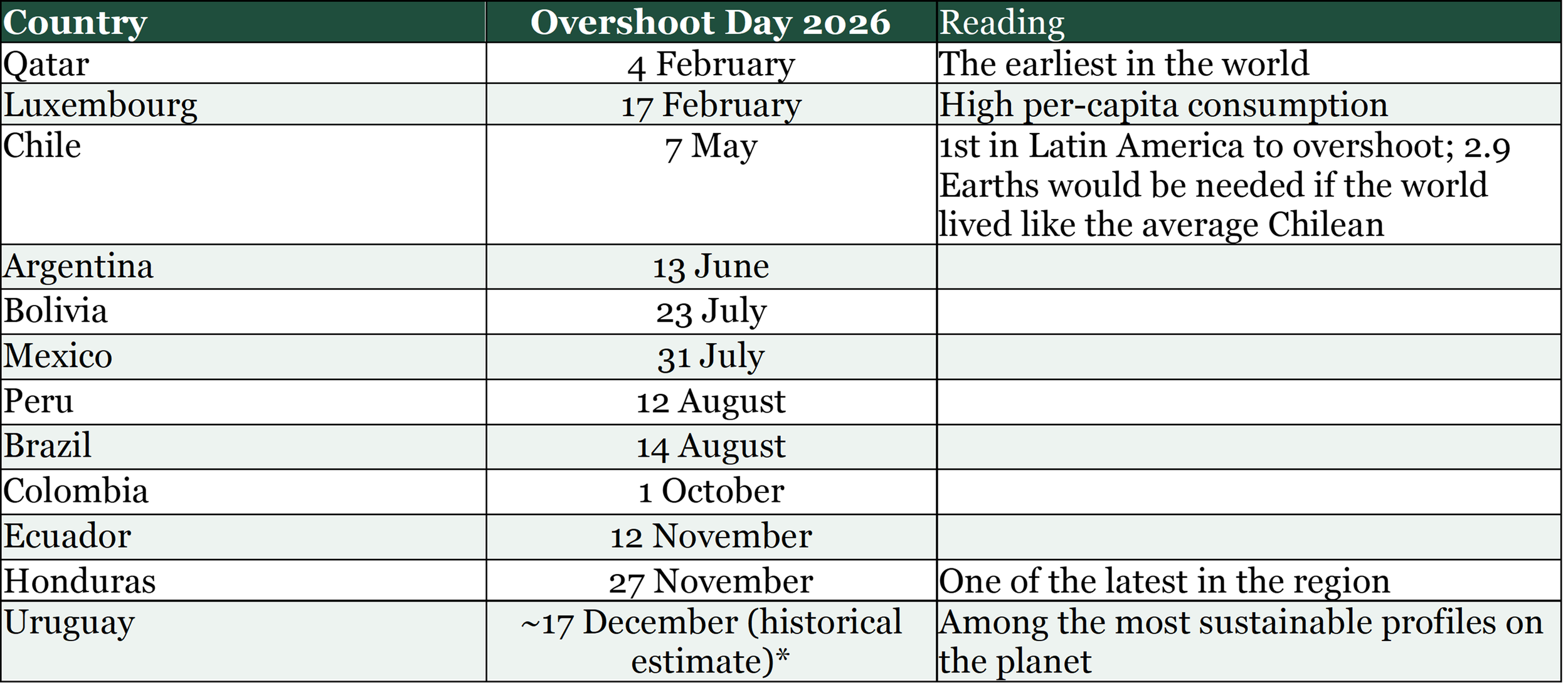
Source: Global Footprint Network / FoDaFo — University of York, “Country Overshoot Days 2026”[7].
* Uruguay was excluded from the official 2026 list owing to data-quality controls; the December estimate is based on its historical Ecological Footprint profile, among the lowest per capita in the world[8]. We flag this transparently: it is an estimate, not an official 2026 figure.
Latin America and the Caribbean illustrate this paradox well. Chile became, in 2026, the first country in the region to enter ecological overshoot — on 7 May — surpassed in the Americas only by Canada and the United States: were the whole of humanity to live like the average Chilean, 2.9 Earths would be required[9]. At the opposite extreme, Uruguay ranks among the most sustainable consumption profiles on the planet[8]. This is, in itself, a geopolitical and reputational asset — what SICS calls biocapacity as a bargaining currency — that the region does not always know how to capitalise on.
Because the other side of this paradox is environmental injustice: the countries that contribute least to global overshoot tend to be those that suffer its consequences most. Mining extractivism, deforestation for commodity exports, and the installation of heavy infrastructure without adequate safeguards shift onto the region’s rural and indigenous communities costs they did not generate. And these costs, viewed through the lens of environmental health and the One Health approach SICS applies in its consulting practice, have a concrete clinical name and epidemiological backing: air pollution from fossil fuels is associated with roughly seven million avoidable deaths a year worldwide, chiefly from cardiovascular and respiratory disease[10]; add to that gastrointestinal and infectious diseases linked to water scarcity and contamination, malnutrition and chronic disease stemming from a food system that prioritises volume over nutrition, and the mental-health toll of an economic model that measures success solely in monetary growth. Ecological overshoot, in other words, sooner or later translates into a health overshoot.
The new frontier of overshoot: artificial intelligence and data centres in Mercosur
If there is one case in which these two dimensions — global ecological debt and regional inequality — converge most sharply today, it is artificial intelligence. AI is advancing at breakneck speed, but behind every generative model lies a physical infrastructure that consumes electricity, water and minerals, and generates electronic waste on a scale much of the public has yet to grasp. The United Nations Environment Programme (UNEP) has put it bluntly: we need AI that is more transparent, efficient and sustainable[11]. A 2026 report by the United Nations University (UNU-INWEH) sets out the scale precisely: by 2030, AI could consume 945 terawatt-hours of electricity a year — nearly three times the combined electricity consumption of Pakistan, Bangladesh and Nigeria — alongside 9.3 trillion litres of water and a land footprint exceeding 14,500 km²[12]. Innovation, SICS insists, should not advance at the planet’s expense.
The current scale, and its trajectory, are already considerable. According to the International Energy Agency (IEA), electricity devoted to data centres rose from 460 terawatt-hours in 2024 to a projected 1,000-plus TWh in 2030 and 1,300 TWh in 2035 under its base case — growth driven chiefly by AI[13]. Training a large-scale language model can consume between 1,000 and 1,300 megawatt-hours — equivalent to the annual consumption of more than a hundred households — and each large data centre can require between 3 and 5 million gallons of water a day for cooling: the consumption of a small city[14]. But training is not what matters most: according to UNU-INWEH, inference — the everyday, mass-scale use once a model is already deployed — accounts for 80% to 90% of AI’s total energy consumption[12]. The challenge, then, is not a one-off computing spike: it is a structural and growing burden on the electricity grid.
This demand has turned Mercosur into an attractive hub for Big Tech investment, thanks to its largely renewable energy matrix, its access to aquifers and its competitive operating costs. But it has also brought very concrete tensions to the surface. In Uruguay, the country’s worst drought in 100 years forced Google to completely redesign its US$850 million data centre in Canelones: the original project envisaged 7,600 cubic metres of potable water a day — equivalent to the consumption of 55,000 people; the final design eliminates the use of water for cooling altogether, replacing it with closed-circuit chillers, and cuts consumption to just 48 cubic metres a day for sanitary use alone[15]. In Chile, the environmental authority partially revoked the permits for a new Google data centre over concerns about water use[16]: the region is already exercising, in practice, the governance this article calls for. In north-eastern Brazil, in states such as Ceará, the installation of data infrastructure amid historic water scarcity generates similar social tensions. Paraguay offers abundant, clean hydroelectric power from Itaipú and Yacyretá, but its transmission grid still faces stability challenges given these new loads. Argentina, by contrast, enjoys a climatic advantage in Patagonia — free-air cooling — that substantially reduces the need for water and energy[17].
From this regional map, SICS draws three governance challenges that no government, development bank or consultancy should underestimate when designing or financing this next wave of digital infrastructure. First, water governance: shifting from open evaporative systems to air-cooling or closed-circuit systems to protect local drinking-water reserves. Second, avoiding so-called “data centre havens”: ensuring that competition to attract foreign investment does not lead to lax regulation that prioritises processing demand over communities’ energy and health needs. And third, managing peak loads on the electricity grid: strengthening local networks so that uninterrupted AI consumption does not crowd out energy supply for regional industry or increase reliance on back-up thermal plants during droughts.
Legitimacy is also measured in the North itself
There is one fact SICS considers decisive for the regional debate, and one that is rarely placed on the table: the society of the very country exporting the AI data-centre model is today, itself, largely opposed to it. According to the Gallup Poll Social Series of March 2026 — a telephone survey of 1,000 American adults — seven in ten (71%) oppose building an AI data centre in their own area, 48% “strongly” so; only 27% favour it[18]. That is a higher level of rejection than the historic opposition to nuclear power plants (53%)[19]. Six further national surveys, using different methodologies, confirm the same trend: Fox News measured 70% opposition[20]; Quinnipiac University, 65%[21]; Emerson College, 63% — a 21-point jump in just seven months[22]; the University of Texas, 56% (62% in rural areas)[23]; and Reuters/Ipsos, in a June 2026 survey of 4,531 people, found that only 33% believe rapid data-centre construction is a good thing, 57% would oppose one in their own community, and 77% fear AI will drive up electricity prices[24]. The average of these six measures of local opposition sits at around 64%; we take Gallup as our central reference, being the largest national random sample and, moreover, the primary source that gave rise to this article.
The generational gap compounds the picture. Pew Research Center, in its “Americans and AI 2026” report (a survey of 5,119 adults, published on 17 June 2026), found that 48% of adults aged 18 to 29 believe AI will have a negative impact on society over the next 20 years — against a mere 14% who see it as positive — the most sceptical generation of all those surveyed, even above the national average (40%)[25,26]. They are, moreover, the heaviest daily users of these tools[26]: the paradox is not that young people reject AI out of ignorance, but that they use it and, precisely because of that, distrust its footprint.
For SICS, this fact entirely reorders the debate over where and how this infrastructure is installed across Latin America and the Caribbean. If the citizens of the country that concentrates the world’s largest AI investment largely reject living alongside its data centres, and its youngest generation is the most sceptical about the technology’s overall balance, then the caution shown by a community in Canelones, in Ceará or in Patagonia is neither resistance to progress nor a sign of the South’s relative backwardness: it is exactly the same legitimate civic reflex already voiced in the North itself. Demanding environmental and health safeguards before accepting a data centre is not a peripheral position that must seek permission from the evidence — it is the evidence. That is precisely the ground from which SICS positions its consulting practice in the world: not as a regional voice reacting to an agenda written in the North, but as a voice of the South engaging as an equal, with the same statistical rigour, on a problem that is already planetary in scale.
Progress without harm: a choice, not a fatality
The study by LUT University and Energy Watch Group demonstrated some years ago that a 100% renewable energy system by 2050 is both technically and economically viable, and would in fact create more jobs than it destroys[27]. Technology, then, is not the obstacle. The obstacle — as Wackernagel himself warns — is the lack of political will, the lobbying of entrenched interests, and an economic model that continues to measure success solely by growth rather than by long-term resource security[2]. “It’s the economy, stupid,” ran Bill Clinton’s famous campaign line; and in the key of overshoot, the phrase holds: sustainability is not an additional noble cause, it is the very condition of possibility for any future prosperity.
Latin America and the Caribbean now have an unusual opportunity: to negotiate their biocapacity for what it is — a strategic asset — rather than selling it cheaply in exchange for short-term investment. That demands the technical capacity to design contracts, regulatory frameworks and environmental and health safeguards that accompany — rather than obstruct — the arrival of artificial intelligence, green funds and bilateral development cooperation. It also demands measuring progress with the same fifteen thousand data points Global Footprint Network uses to measure overshoot[1]: rigorously, comparably and verifiably, not merely with the aspirational language of sustainability.
This year’s Overshoot Day is a reminder of something SICS repeats in every environmental and health consulting project it undertakes: the question is not whether the world can afford to innovate, but whether it can afford to keep innovating without measuring the ecological and health cost of that innovation. The only answer defensible on the evidence is that progress is sustainable only when it is designed to do no harm.
Seniors International Consulting (SICS)
Environmental health, One Health and development geopolitics consulting. This article reflects SICS’s institutional position on the relationship between innovation, sustainability and public health in Latin America and the Caribbean, and its aim of positioning itself as a leading global voice from the South.
References (Vancouver style)
All sources consulted in drafting and verifying this article are listed, in order of appearance in the text, following the Vancouver citation style. Multilateral bodies and technical agencies (IEA, UNEP, WHO, IPCC, UN University) are prioritised as primary evidence; press coverage and opinion polls are cited as social context and cross-verification, not as primary scientific evidence. Extensive, traceable evidence is, for SICS, central to institutional trust.
1. Global Footprint Network. Anuncio del Día del Sobregiro de la Tierra 2026 [in Spanish] — Press release [Internet]. Geneva: Global Footprint Network; 5 Jun 2026 [cited 30 Jul 2026]. Available from: https://overshoot.footprintnetwork.org/newsroom/press-release-june-2026-spanish/
2. Wackernagel M. Huella Ecológica: Gestionando nuestro Presupuesto de Biocapacidad [in Spanish]. Interview/presentation [ca. 2020–2024]. Reference document supplied by the client.
3. Heinrich-Böll-Stiftung. Report on Earth Overshoot Day: components of the Ecological Footprint and #MoveTheDate solutions. Reference document supplied by the client.
4. National Oceanic and Atmospheric Administration (NOAA). Annual Greenhouse Gas Index (AGGI) [Internet]. Boulder (CO): NOAA; [cited 30 Jul 2026]. Available from: https://gml.noaa.gov/aggi/aggi.html
5. Intergovernmental Panel on Climate Change (IPCC). Climate Change 2023: Synthesis Report. Contribution of Working Groups I, II and III to the Sixth Assessment Report [Internet]. Geneva: IPCC; 2023 [cited 30 Jul 2026]. Available from: https://www.ipcc.ch/report/ar6/syr/
6. Cabrera A. Argentina, Bolivia y México agotarán sus recursos naturales regenerativos anuales a mitad de 2026 [in Spanish] [Internet]. Radio Santa Fe 1070 am; 13 May 2026 [cited 30 Jul 2026]. Available from: https://www.radiosantafe.com/2026/05/13/argentina-bolivia-y-mexico-agotaran-sus-recursos-naturales-regenerativos-anuales-a-mitad-de-2026-colombia-lo-hara-hacia-el-1-de-octubre/
7. Global Footprint Network / FoDaFo — University of York. Country Overshoot Days 2026 [Internet]. Dec 2025 [cited 30 Jul 2026]. Available from: https://overshoot.footprintnetwork.org/newsroom/country-overshoot-days/
8. Global Footprint Network. National Footprint and Biocapacity Accounts — Uruguay profile [Internet]. [cited 30 Jul 2026]. Available from: https://data.footprintnetwork.org/ (Uruguay excluded from the official “Country Overshoot Days 2026” list owing to data-quality controls; estimate based on its historical profile).
9. Pavesio L. Chile es el primer país de Latinoamérica en agotar sus recursos naturales y entra en sobregiro ecológico 2026 [in Spanish] [Internet]. Noticias Ambientales; 7 May 2026 [cited 30 Jul 2026]. Available from: https://noticiasambientales.com/medio-ambiente/chile-es-el-primer-pais-de-latinoamerica-en-agotar-sus-recursos-naturales-y-entra-en-sobregiro-ecologico-2026/
10. World Health Organization (WHO). Ambient (outdoor) air pollution — Fact sheet [Internet]. Geneva: WHO; [cited 30 Jul 2026]. Available from: https://www.who.int/news-room/fact-sheets/detail/ambient-(outdoor)-air-quality-and-health
11. United Nations Environment Programme (UNEP). La IA plantea problemas ambientales. Esto es lo que el mundo puede hacer al respecto [in Spanish] [Internet]. Nairobi: UNEP; 2026 [cited 30 Jul 2026]. Available from: https://www.unep.org/es/noticias-y-reportajes/reportajes/la-ia-plantea-problemas-ambientales-esto-es-lo-que-el-mundo-puede
12. United Nations University Institute for Water, Environment and Health (UNU-INWEH). Environmental Cost of AI’s Energy Use: Carbon, Water and Land Footprints [Internet]. Hamilton (CA): UNU-INWEH; 3 Jun 2026 [cited 30 Jul 2026]. Available from: https://unu.edu/inweh/news/environmental-cost-of-AIs-Enrgy-use-carbon-water-and-land-footprints
13. International Energy Agency (IEA). Energy and AI [Internet]. Paris: IEA; 2026 [cited 30 Jul 2026]. Available from: https://www.iea.org/reports/energy-and-ai
14. Data Center Asia. How much power does a data center use? [Internet]. Hong Kong: Data Center Asia; 2025 [cited 30 Jul 2026]. Available from: https://www.datacenter-asia.com/blog/how-much-power-does-a-data-center-use/
15. El Observador. Proyecto de Google en Uruguay: más chico y con un edificio menos tras cambio en el sistema de enfriamiento [in Spanish] [Internet]. Montevideo: El Observador; 21 Nov 2023 [cited 30 Jul 2026]. Available from: https://www.elobservador.com.uy/nota/sin-agua-con-enfriamiento-por-aire-y-un-edificio-en-lugar-de-dos-los-detalles-del-proyecto-de-google-en-uruguay-2023112116100
16. Data Center Dynamics. Chile revoca parcialmente los permisos al nuevo centro de datos de Google por preocupaciones sobre uso de agua [in Spanish] [Internet]. [cited 30 Jul 2026]. Available from: https://www.datacenterdynamics.com/es/noticias/chile-revoca-parcialmente-los-permisos-al-nuevo-centro-de-datos-de-google-por-preocupaciones-sobre-uso-de-agua/
17. Crónicas (Uruguay). El costo energético de la revolución de la IA: por qué los centros de datos ponen a Uruguay en el mapa global [in Spanish] [Internet]. Uruguay: Crónicas; [cited 30 Jul 2026]. Available from: https://www.cronicas.com.uy/news-68929-el-costo-energetico-de-la-revolucion-de-la-ia-por-que-los-centros-de-datos-ponen-a-uruguay-en-el-mapa-global
18. Gallup, Inc. Gallup Poll Social Series: The Environment — Final Topline [primary document]. Washington (DC): Gallup; survey conducted 2–18 Mar 2026. Princeton Job #26-03-003.
19. Jones JM. Americans Oppose AI Data Centers in Their Area [Internet]. Washington (DC): Gallup News; 13 May 2026 [cited 30 Jul 2026]. Available from: https://news.gallup.com/poll/709772/americans-oppose-data-centers-area.aspx
20. Fox News. Fox News poll finds voters oppose data centers by 40-point margin [Internet]. 2026 [cited 30 Jul 2026]. Available from: https://www.foxnews.com/politics/fox-news-poll-cool-your-servers-voters-reject-data-centers
21. Quinnipiac University Poll. The Age of Artificial Intelligence: Americans’ AI Use Increases While Views on It Sour [Internet]. Hamden (CT): Quinnipiac University; 30 Mar 2026 [Release ID 3955; cited 30 Jul 2026]. Available from: https://poll.qu.edu/poll-release?releaseid=3955
22. Emerson College Polling. Pennsylvania Survey on Data Centers & Artificial Intelligence [Internet]. Boston: Emerson College; Jul 2026 [cited 30 Jul 2026]. Available from: https://emersoncollegepolling.com/pennsylvania-survey-on-data-centers-artificial-intelligence/
23. Texas Politics Project, University of Texas at Austin. Majority of Texans oppose data center construction. In: The Texas Tribune [Internet]. 23 Jun 2026 [cited 30 Jul 2026]. Available from: https://www.texastribune.org/2026/06/23/texans-oppose-data-centers-poll/
24. Reuters/Ipsos. Americans wary of AI-driven data center boom, Reuters/Ipsos poll shows [Internet]. 11 Jun 2026 [cited 30 Jul 2026]. Available from: https://www.reuters.com/world/us/americans-wary-ai-driven-data-center-boom-reutersipsos-poll-shows-2026-06-11/
25. Gottfried J, Bishop W, Anderson M, Faverio M, Park E, McClain C. Americans and AI 2026: Chatbots, Smart Devices and Views on Impact [Internet]. Washington (DC): Pew Research Center; 17 Jun 2026 [cited 30 Jul 2026]. Available from: https://www.pewresearch.org/internet/2026/06/17/americans-and-ai-2026-chatbots-smart-devices-and-views-on-impact/
26. McClain C, Gottfried J, Bishop W, Anderson M, Faverio M, Park E. How opinions and use of AI differ by age [Internet]. Washington (DC): Pew Research Center; 17 Jun 2026 [cited 30 Jul 2026]. Available from: https://www.pewresearch.org/internet/2026/06/17/how-opinions-and-use-of-ai-differ-by-age/
27. LUT University, Energy Watch Group. Global Energy System Based on 100% Renewable Energy [Internet]. Lappeenranta / Berlin; [cited 30 Jul 2026]. Available from: https://energywatchgroup.org/wp/en/new-study-global-energy-system-based-100-renewable-energy/
28. Global Footprint Network. How Earth Overshoot Day 2026 Was Calculated [Internet]. 2026 [cited 30 Jul 2026]. Available from: https://overshoot.footprintnetwork.org/2026-calculation/